Wednesday, May 17, 2006

Something Called Pioneer Days


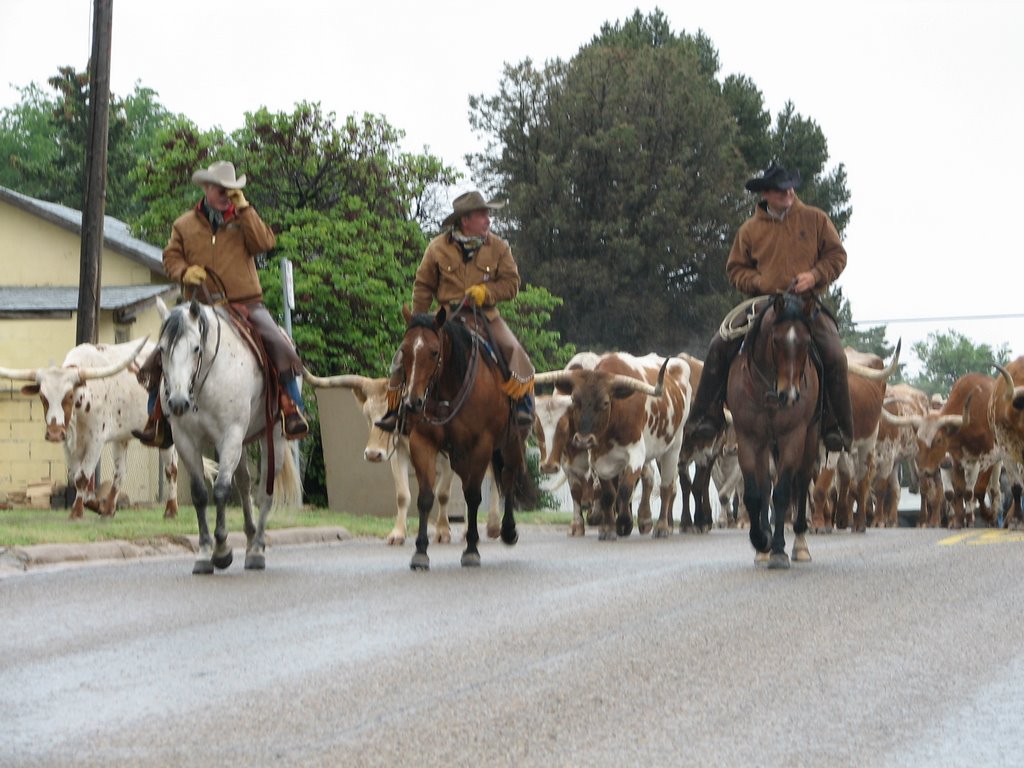
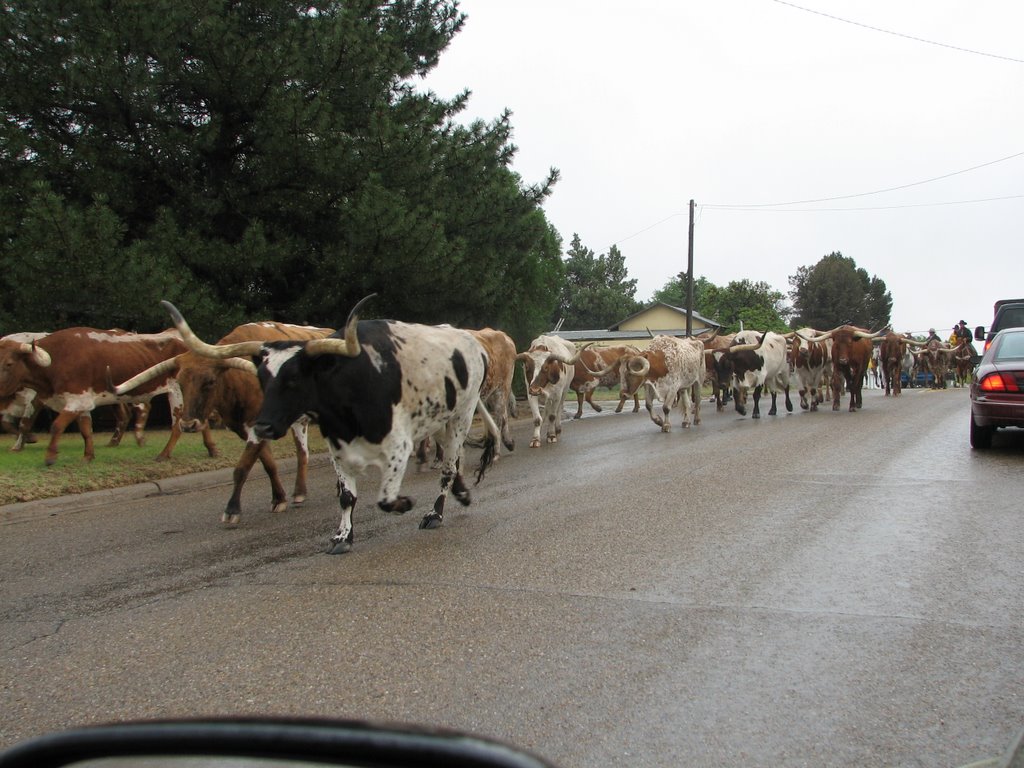
Guymon captures (and perhaps holds hostage) its "No Man's Land" identity in a celebration called Pioneer Days. There's a Dodge Rodeo, carnival, craft fair, and a parade. Now this might sound innocent enough, but there's something about the parade that everyone should know. This is not a normal sort of thing that happens at every parade, in fact it is not just for mere knowledge that I'm telling you all this. It is so that you will lock up your children, cover their eyes and don't stand too close to the road. For that matter, do not even come out in public without the ability to ward off the greatest of fears. At any moment, something horrifying could happen. Protect those you love, because the longhorns are coming.

You see, someone, at some point in time thought it would be a good idea to drive several head of cattle through the downtown during the parade. Now, granted I can't speak of no incident of violence this has caused, but it frightens me nonetheless. I have included a few pictures so that those of you who do not know or have not been to Guymon may see the insanity that is a cattle drive through the streets.

Sunday, April 30, 2006

Flying the Coop


Since we're so far away from home these days, my Mom sends me pictures of family events we can't attend. I see these kids, 2-3 generations away from me, sons and daughters, in the same images and stories I've heard before. These are pictures of cousins leaping off the top of our chicken coop to ride the bag swing. Apparently the roof of the barn was not good enough. They moved the ladder to the coop, step off onto the refrigerator and swing away. Didn't Uncle Paul once try this once with an umbrella? I've seen U. Marvin, A. Bess, and A. Carol, swinging their blackened feet out of the hay mow -- 12+ feet above the ground.

We often reject ritual out-of-hand as meaningless or insignificant. Yet like any gift of grace, it is not so much a matter of what we are able to bring to it as it is discovering what is already and always there. These stories of flying off windmills and falling off tractors should be a part of these 4th and 5th generation sons and daughters as much as they are to our ancestors. They should not experience failing memories on our account.

The accomplishments and "relative" happiness of my family is not by accident. It is reinforced through the annual rituals of pinatas, name eggs, familiar photos, John Deere tractors, juicy watermelons.

Either our family is not afraid of heights or we find ourselves doing what families do best -- reliving and renewing the rituals and traditions that have shaped our lives for years, centuries, millenia. We are grounded in these things. They are what allow us to take the leaps of faith and ambition we need to fly.

Tuesday, April 25, 2006

Lines Written Over Dogs Barking Next Door

What are the sounds that move us from where we are to
where we would like to be, from here to who we want to be?
The sounds of honking horns and the only-in-a-city hums
remind us when we leave the city behind for something
not so city that there is such a thing as silence. Listen to
the click of a turned knob, the drip of water to drain.
The sounds of the wind in the winter and spring keep us
up on the memories and hope for the gentler, warmer,
a summer and early fall breeze.

The dogs next door bark at night, the sound of sirens, the cat
and dog breathing at the foot of the bed. They are all reminders
of life. Now awake thinking about the sounds of life, hear it,
the baby cries in church, and not everyone hears the real liturgy.
Some complain, disturbed and distracted, those also
bothered by other naturalnesses of children. That is not
the real sound heard. The baby cries again (sacramental)
during Word spoken from prophet, all of heaven rejoices,
I whisper, “Thanks be to God.”

Sunday, April 23, 2006

Hands and Feet


John 20:19-31
It was a crazy idea. That these very tiny little things -- invisible, in fact -- are the building blocks of the universe. Atoms! So tiny that they are indivisible. This would explain so many things, and yet because they are invisible there’s no way to prove it!

Believe it or not, this is what a crazy Greek man named Democritus conceived over 2400 years ago. Amazing that this man with no microscopes, no particle accelerators, no nano-technology, should come up with such an unbelievable idea. It would take 2000 years for such an idea to actually take hold in the minds of scientists and philosophers. But we believe it today . . . not so much because we’ve seen the atom ourselves, but because we’ve been told enough times and with the sufficient evidence to know that they exist.

Split one and we can cause the universe to collapse in on itself.

Evidence is really a hard thing. Evan and I love watching CSI – all three of them – Las Vegas, Miami, and New York. They pull little hairs out of carpet with tweezers, test white substances, boil bones. Juries convict on this stuff. It seems that the modern age does not require so much of a logical argument as much as it does good solid physical evidence. Stuff that we can see and touch and taste.

And we find our CSI’s at work here in this passage. For Thomas gives us a pretty understandable response when confronted with the suddenly fearless testimony of some previously very fearful disciples. Jesus had appeared to a shivering group of weary bleary followers. He showed them His hands and his side. He let them touch them. It still seemed like a dream. So when Thomas arrived, having missed the whole thing, you could understand his skepticism, right?

But now, poor Thomas, has been singled out. He sits right above Judas in the hierarchy of good disciples. We forget the disciples who were there were shown the same thing that Thomas demanded to see. Did they really ever have a faith any different than doubting Thomas?

Perhaps John is trying to tell us something here. Something besides a Jerry McGuire, “Show me the money!” kind of belief. A faith vomited up out of fear – fear of the Jews, fear of what is on the other side of the door, fear of death. They were all fearful. Thomas just said it out loud.

But Jesus’ response to Thomas, indeed to all the “believers,” was to let them poke into his side, and to stick their fingers into the holes and right out the other side. Jesus had the evidence that He was alive for those very people who had seen him die. Whether they should have needed it or not. It was His body itself, risen and glorified, that proclaimed the arrival of the Kingdom of God and redemption of all creation. They needed to see that because the world that is upside down had been turned right side up again.

Of course, Thomas’ response was the one of faith. He exclaims, “My Lord and my God!”

And Jesus does not deny him the recognition or the understanding.

An understanding not so much about what it was he was seeing but what it meant to see it.

For if Thomas hadn’t believed Jesus had been raised from the dead, how would he have believed the redemption fulfilled in this resurrection?

The commentator writes, “But belief itself comes from another source than evidence. It is a gift of God.”

Indeed, even our faith is something we can make up and work or will to ourselves. It is a gift we must receive only with fear and trembling. It is only formed in the moments we realize there is nothing else we can do to conjure it up, to squeeze it out. Only after enemies have left us defeated, and our efforts have left us worn out. When there nothing to have faith in . . .

I confess I am a doubter. Sometimes it’s not enough just to be told my God is faithful. That He does what He says He will do. I see His faithfulness in the lives of others – dreams fulfilled, plans carried out, redemption gained – I’m not always encouraged.

I read John’s words about why he wrote this story, “But these are written so that you may come to believe that Jesus is the Messiah, the Son of God, and that through believing you may have life in his name,” and I sense the struggle in these people.

I was not there on the hillside when Jesus fed the five thousand. I was not there when he calmed the storm. I was not there as he died on the cross. I did not wrap his body in strips of cloth. I did not hide in a dark room eluding the Jews. What evidence do I have that Jesus was and is who he says He is – the Son of God, the Son of Man, the Savior and Redeemer of the world?

I wonder where is this belief in my life? Where is God’s faithfulness? What is there to understand? Slogging through indecision, indifference, mediocrity, I’m looking for hands and feet, holes and marks and scars.

Science tells us that patterns of past behavior do not predict future behavior. Can this be true of God as well?

John writes to his beloved community and to us about what to do when we’re not seeing what we’re supposed to be believing.

And Jesus’ reproachful statement, “Have you believed because you have seen me? Blessed are those who have not seen and yet have come to believe,” is perhaps the beginning of that gift.

Our psalm concludes, “The fear of the LORD is the beginning of wisdom; all those who practice it have a good understanding.”

And in this Easter story we see certainly see fear. Fear of the Jews had lingered for days in the dark corners of their hiding places. They did not know what to believe. Jesus had told them what would happen, yet they still dreaded the knock on the door.

Jesus did not knock, but stood among them – literally breathing upon them his very presence. To touch his wounds meant no more fear and no more dealing. And doubting Thomas would be the first to proclaim what that presence meant – God with us.

He should be the one to remind us that it is the poor in spirit who inherit the Kingdom of God. Those who mourn will be comforted. Those who hunger who will be filled. Those who doubt will be met with scarred hands and wounded side.

What is understanding? Nothing that is not a gift of God. Do we come with faith to this Table? Should we, full of ourselves and our confident, nuanced, sophisticated faith? As if our faith is our backstage pass, our special clearance into these special rites and privileges.

Or may we come as Thomases with our eyes wide open in disbelief but our stomachs pained and growling ready to eat until we are filled?

I hope that we are not already there, that we might admit that we actually need Christ’s living breathing Spirit in our life and not our own hot air. Funny thing, Jesus knew then as He knows now, that we do need to get a grip on things sometimes. Let Him breathe upon us.

And today I invite you to this Table, to touch his broken body, and live again.

Julia, Word & Table Homily
Friday, April 21, 2006

Land Run of 1889


Today, I was trying to think of my favorite school memory. This is a difficult thing for me as I attended a great number of schools. It is not a spectacular memory, nor is it particularly favorable in any normal sense of the word. Perhaps favorite is not the word for it. Perhaps a better word is memorable. Anyway, there are two. In the third grade I was tossing my pencil end over end up into the air (while the teacher wasn't looking). The very last time I ever attempted this, ever, I caught the pencil with my left hand. Well, sort of. I actually caught it with my left ring finger. Okay, I caught it in my left ring finger. The tip of my pencil stuck gloriously into the tip of my left ring finger. To this day there is graphite still in that finger.

The other memorable moment of my school years was in the fifth grade, when the Space Shuttle Challenger exploded. I remember our school turned on the newly purchased room televisions and we watched the footage. It was disturbing. I remember feeling infinitely sorry for the students of the teacher who was on board.

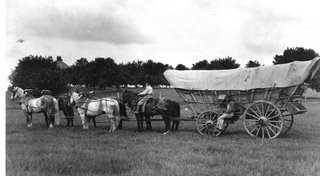
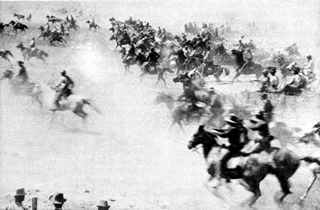
There you have it. My most memorable moments in school . . . That is until today. While I am not in primary school now, I can say that I experienced the very best of my primary school moments today. It was the 5th grade project on the Oklahoma Land Run of 1889. President Benjamin Harrison declared 2 million acres of government land open when Illinois rep. William Springer amended the Indian Appropriations Bill. Suddenly, those folks who wanted 150 acres of free land lined up and at noon (although, some were litigiously confused whether it was high noon or meridian noon) on April 22, 1889, the gun fired and they were off.

Much like this historical moment so many years ago, the 5th grade students, with on looking parents, grandparents, teachers, and a children's pastor, lined up their make-shift covered wagons and supplies. When the powder musket fired, the kids ran, wagon in tow, for a pre-placed stake of land. Once they had staked their "family" name on their land, they had to put up a tent, gather food and water, and then return to "town" for the deeds to their land.

I spoke with a few parents of the children involve who were both excited for the run and relieved that they no longer had to help with the building, cooking, and creation of things for the run. One parent, who had participated when she was in 5th grade said, "This was my favorite school memory." I turned to her and said, "It's mine too, now."

Tuesday, April 11, 2006

Betrayed

It was a hot night and Jesus had just done the unthinkable. He had washed the feet of his disciples. Now, understand that Jesus’, God with us, King of Glory, washed his own servant’s feet. I barely want to touch my own feet, much less anyone else’s feet. Yet, Jesus washes his disciples dirty, nasty feet on this hot night in the upper room. When he finished he said a few things about someone who would take some bread and betrayal. But who would betray Jesus? They’d all seen who Jesus really was.

Judas son of Simon Iscariot betrayed Christ. We’ve all heard the story. We’ve heard it from Sunday school teachers, in sermons, read it, and to some extent, we glaze right over it. We’ve heard the stories of Judas and his repulsion of Mary’s anointing of Jesus’ feet with expensive perfume. “Master, that stuff’s worth a fortune. We could sell it and give the money to the poor.” Hear Judas thinking, “I’m poor, after all. I sure could use the cash.” “Judas, don’t you get it.” Jesus said, “There’s always going to be poor folk and you’re always going to be poor. I won’t always be with you.” Judas’ hated to be publicly humiliated like that, especially in front of that whore, Mary.

We’ve heard the story of this night too. It was Judas who would betray his Lord. Jesus was upset and everyone there could see it in his face. It was pure pain, the weight-of-the-world-on-his-back kind of pain, to say it out loud. After all, Judas means “praised.” He was one of the twelve, not the new and improved twelve (Now With Mathias!), but the original formula, classic disciples. Jesus looked around at the twelve and said, rather laconically, “One of you is going to betray me.”

Instantly the whispered chatter spread around the room, Peter talking to Bartholomew, John and James exchanging the knowing and silent language of brotherhood, Mathew and Thaddeus exchanging questioning gestures with Phillip and Thomas. Judas, shifty eyed, looked at everyone and refused eye contact with anyone. The chatter, though, was broken by the Word of God, “The one to whom I give this crust of bread after I’ve dipped it.” Hmm, that’s funny that Jesus would still offer himself, as if giving the betrayer a second chance. There’s Jesus always the redeemer. Jesus dipped the bread into the wine and gave it to Judas. Judas took the wine soaked bread in his hand and the shadow of decision passed behind the pupils of his eyes.

Jesus said, “Whatever you are going to do, do it. Do it and get it over with. Quit putting off whatever decision you were going to make.” In that moment, I think of Joshua standing before the Israelites. If you are going to serve God, then serve him. If you are going to serve Baal, serve him, but choose already. Quit bouncing back and forth at your whim. Not one of the disciples around the table knew why Jesus said this to Judas. Some of them even thought he’d just needed to buy stuff they needed for the Passover feast, or that he needed to help some poor folk. Judas stood up, with the dripping, now soggy, piece of bread, and left. He made his choice. It was dark out.

But that is not the end of our scripture on this Holy Wednesday. It doesn’t stop there. It doesn’t stop with this dark and lonely moment in that upper room. After Judas had left, he spoke again, “Now you know who I am, who I really am. Now you know who God is. God’s glory will be on display for everyone to see.” He went on, “Listen. I am not going to be with you for much longer. You’re going to look for me, but I’m going places that you can’t go.”

And here it is. This is Christ’s answer to the betrayer. This is how God answers those who would act the part of supporter, friend, confidant and then turn around and hand him over to his enemies. This is how the Christ responds to the one who should have spoken for him, but instead took a measly penance of a bribe to have him killed. Jesus said, “Let me give you a new command: Love one another. No matter what happens. No matter who stands against you. No matter what others say about you. No matter which of your friends, spouses, children, bosses, co-workers speaks out against you. You are to love one another. Love each other just like I showed you how, just like I modeled it for you. You asked what love looks like? It is the washing of the feet, the laying down of one’s life.” Jesus looked at each one of the remaining disciples and said, “You know why I want you to love one another? Because when you love one another, like I love you, without expecting it in return, shameless love, scandalous love, when you do that everyone will know exactly whom you follow. They’ll know me when they see the love you have for each other.

As we look toward Good Friday, horribly, terribly Good Friday, I want you to remember to love one another. It’s not an easy thing, but it is the thing that marks you as whole and holy citizens of the Kingdom of God.

[this is based on the lectionary Gospel reading for Holy Wednesday, John 13:21-35]

Wednesday, March 22, 2006

Ketchup


A papa tomato, mama tomato, and a baby tomato were walking down the street. Baby tomato was a little slow and kept falling behind. Finally Papa tomato couldn't take it anymore, walked back to Baby tomato, and stomped on him squishing him completely. Papa tomato said, "Ketchup!"

It's true. I have not written here in a month. But here is my short, ketchup. I have been building a puppet set, remodeling a bathroom (completely), taking an online class (history and polity of the Church of the Nazarene), trying to keep from slumping into a deep depression, writing some poetry, maintaining a love affair with my wife, working fifty to sixty hour work weeks, and much more.

There you have it. Ketchup.

Did you ever wonder who invented/discovered ketchup? Do you know the difference between ketchup, catsup, and fancy ketchup or catsup? Ketchup was originally the word used for sauces in general. Typically a mushroom sauce or fish sauce. In the 1800s ketchup referred to any sauce using vinegar, but as the century progressed, along with the increasing obsession Americans had with tomatoes, ketchup became a tomato based sauce. In the 20th Century, modern ketchup took off in popularity. Due to an argument with the food and drug administration over the use of sodium benzoate as a preservative in condiments, Henry J. Heinz began working on a recipe that didn't include sodium benzoate. Now, ketchup is used everywhere to cover the taste of crappy fast food. As for the difference between ketchup and catsup? I don't know.

Sunday, February 12, 2006

The Peace of Sabbath Things


I would like to continue a recent discussion about poetry and theology. As I have said before, poetry is a prayerful speech that will dance with words far longer than words will dance by themselves.

I want to share another poem of which this Lords Day has reminded me. I had the honor to return to a church of which I was on staff a couple of years ago. St. Paul's church of the Nazarene lavished God's grace on me today. Today the wood drake rested its beauty in the midsts of the people of St. Paul's. Thank you Father for the rest I found in sabbath.

The Peace of Wild Things
by Wendell Berry

When despair for the world grows in me
and I wake in the night at the least sound
in fear of what my life and my children's lives may be,
I go and lie down where the wood drake
rests in his beauty on the water, and the great heron feeds.
I come into the peace of wild things
who do not tax their lives with forethought
of grief. I come into the presence of still water.
And I feel above me the day-blind stars
waiting with their light. For a time
I rest in the grace of the world, and am free.

Tuesday, February 07, 2006

Do You Need God?


I decided to post my sermon from this past Sunday. Let me know what you all think?


The Gospel reading is Mark1:29-39.
The Gospel of Our Lord.

Now, I don’t know about all of you, but there’s got to be a reason Jesus healed Peter’s mother-in-law. Perhaps Jesus knew how much Peter loved his mother-in-law, right? Or maybe the joke was on Peter. Is it any surprise Mothers-in-Law Day is less than a week before Halloween? Hey, what do you call your mother-in-law buried up to her neck in sand? Not enough sand. No, I’m just kidding. I love my mother-in-law. Anyway, we see in our gospel reading this morning something really amazing. We see Jesus at the beginning of his ministry teaching, healing, casting out demons. This is God. The God of creation revealed to us and revealing to us the Kingdom of God is in the flesh and preaching the Good News fulfilled in the resurrection. He is preaching that we, in all of our brokenness can be whole and holy.

But, now, that I’ve read our Gospel scripture this morning, I want to tell you another story. This one comes from 2 Kings chapter 4. The hero in this passage is Elisha. I’m sure all of you have heard of this prophet Elisha. He and his predecessor Elijah were bright spots in Israel’s history. There were a lot of folk who just weren’t real nice. Elijah had been taken up and left the lot of his work as a prophet to Elisha. Elisha was teased by children, and I’ll let you read that story on your own in chapter 2:23-25. Elisha gave a word to the Kings of Israel, Judah, and Edom and they had water for their men and animals during battle. Then we come to chapter four. Our hero Elisha is confronted by the widow of one of his followers. She was distraught with the fear of not only losing her husband, but loosing her two children as well. You see, the man had quite a bit of credit card debt built up and because he died before he paid it back, the debt was transferred to his wife and children. Back then, any unpaid debt that defaulted meant the payment would’ve been the children or even the wife. The widowed mother was heartbroken at a point of unbearable grief. And at that point of grief, this widow looked to Elisha.

Elisha asked her what she wanted him to do. “What do you have in your house?” He asked her. She said, “I’ve got nothing, unless of course you count this jar of oil.” Elisha said, “I want you to go out and borrow jars and Tupperware and Rubbermaid containers from everyone you know and not just a few; get a whole bunch. Then go into your house, shut the door behind you, and start pouring the oil from the jar you have into the borrowed Tupperware.” So, she did just as Elisha had told her. Her children traded out the containers as she poured and poured and poured the oil. She poured each container up to the brim until there were no more containers, then, this ever flowing jar of oil stopped flowing. She ran to tell Elisha the great news and he told her, “Now sell the oil, pay off all of your credit cards, and live on the rest.”

Once again we see our great provisional God working in the world. Here again we see the God of creation at war against this world that works so hard to subvert his love with poverty, pain, and sadness. But God is bigger than poverty. And he answered this woman’s request with gusto. He not only took care of her debts, but also provided for her and her children’s lives. Considering her place in the story, we know she was faithful. She didn’t come to Elisha because he owed her anything for all the years of service her husband provided Elisha. She came to him in faith, knowing that God would provide. And oh, how he provided.

One day Elisha was passing through a town called Shunem. There was a very wealthy woman there who asked Elisha to come and eat with her and her husband. Elisha became close to the couple and ate meals with them anytime he passed through the town. Knowing that Elisha was a prophet of God, the woman talked her husband into building on a room for Elisha to stay in anytime he came to town. What a gift. When Elisha was back in town, they showed him up to his room. He was so pleased. Elisha laid down on his bed, it must have been one of those pillow top mattresses or maybe even a sleep number set to his ideal firmness, because he had his servant, Gehazi, bring the woman up to his room. Elisha wanted to thank her for going to all the trouble of building and preparing a room for him. He asked her if there was anything he could do for her. “Can I tell the king of your kindness? Or maybe I can put in a good word to the general for you?” She said, “No, thank you. I am just from a small town and don’t really want a lot of attention.” Elisha said, “What can I do to thank you, then?” The woman answered, “Well, there is one thing, you see, I can’t have kids and I’d really like to have a son.”

I have to stop here and let you in on a little secret. Throughout the Bible there are stories of little old barren women. And I can tell you that when a little old barren woman cries out to God, he hears. Just ask Sara, Rebekah, Rachel, Samson’s mother, Hannah, Elisabeth. I’m not one to make broad sweeping statements about God, but God is faithful! He is our deliverer and in the case of these women, he is literally their deliverer as he delivers babies for them. But, back to our hero, Elisha.

Elisha said to the woman, “This time next year, you will hold your very own little baby boy!” The woman’s jaw dropped. She said, “Now, don’t joke around with me. I’m too fragile to be tricked.” Elisha said, “No joke.” The next day, he left for other business throughout the country. In a few months time, the woman became pregnant. And a year after Elisha told her, she had her own baby boy. As the little boy grew up he would work out in the fields with his father. His father looked over at him just as the boy grabbed his head and complained of a really bad headache. His father was worried about him and had his servant take him into his mother. She held him on her lap until noon, and he died. Immediately she took him up to Elisha’s room and laid him down on Elisha’s bed. She told her husband that she was going to take a servant and go visit Elisha. He said, “But it’s not sacrifice time and it’s not even the Sabbath. Why go to him now?” The woman answered, “Don’t worry about it. Everything will be all right.”

Now, keep in mind that everything was not all right. Her son just died in her arms, her only son. Of course everything was not all right. Yet she made this pure, crystal clear, statement of faith. And that’s what it was, wasn’t it? It was a statement of faith. Can you hear the echos of Abraham answering Isaac’s questions about the ram? God will provide. Listen to this woman say, “It will be all right. God will provide.” Oh, to have that much faith in the everydayness of my life. What a testimony to God’s faithfulness! But I digress. Let’s get back to our hero Elisha.

The woman saddled up her donkeys and left, telling the servant not to slow down for her. He needed to get news to Elisha. As she approached Mr. Carmel, Elisha saw her and immediately knew something was wrong so he sent Gehazi, his servant, to meet her. Once again, when Gehazi met her and asked what was wrong she answered, “It is all right.” But when she made it to where Elisha was, the wealthy woman jumped down off of her donkey and violently grabbed a hold of Elisha’s feet. She immediately began questioning Elisha, “I asked if you were kidding me when you said the Lord would give me a son! I made you swear that you weren’t just giving me false hope! He said to Gehazi, “Gird up your loins.”

Now, let me take just a moment here to ask, “What is girding up your loins?” Wait, nevermind!

Elisha told Gehazi to go quickly, not stopping for anyone or anything, and lay his staff on the boys face. Gehazi went on ahead. But this didn’t satisfy the woman. She insisted that Elisha go home with her. So, he did. When Gehazi arrived at the woman’s home, he did just as Elisha had told him and placed the staff on the boy’s face. But there was no sound or sign of life in him. When Elisha finally made it to the house, he saw the child dead on his bed. He went in, closed the door, and immediately started to pray to the God of Life. Then, Elisha did the most remarkable thing. This is where the story takes on life of its own, so to speak. Elish stood up from kneeling. He looked down at boy’s lifeless body. And then he climbed up on the bed and laid right across him with his hands on the boy’s hands, his eyes on the boy’s eyes, and his mouth on the boy’s mouth as though it were some sort of holy mouth to mouth resuscitation. As he did this, Elisha felt the child’s body warm up. He climbed down off the bed and paced once back and forth across the room. Then, he climbed back on top of the boy, and immediately, the boy sneezed seven times. He sneezed! Sneezed! I said that three times in case you didn’t here me the first or the second. The dead boy sneezed and then opened his eyes. He was alive and well. Elisha had Gehazi call in the Shunamite woman. When she saw her living son, she fell at Elisha’s feet and immediately took her son down to his father and said, “See, see! I told you it would be all right!”

The Shunamite woman knew that God would be faithful and deliver her son. She knew that she knew that she knew! Because you have to know that poverty still offers hope. Hunger still has the pangs of hope in the growl that precedes even the smallest crumb of bread. But in death, there is not hope, none at all. Death is the ultimate hopelessness. And resurrection is the ultimate end to hopelessness, breaking it into a million little pieces. If God’s power and love cannot bring life to the lifeless, then what good is money or food or good health? Now, imagine what this story means to us as we are resurrected with Christ. Isn’t God good?

But it’s not over because when Elisha returned to Gilgal (and by the way, I mentioned Mt. Carmel earlier and Gilgal now because these are the two places that most reflected faith for these now settled Hebrews.) there was a famine. The group of prophets that Elisha was discipling was there with him. He told his servant to fix a big pot of stew. The servant went out and gathered up some herbs and spices from the garden. He found some wild gourds just on the other side of the garden and grabbed some of those, thinking it would be good in the stew. The servant sliced up the herbs and the gourds and cooked it all together. As he proudly served his stewed creation to the best prophets in all of Israel and Judah, he awaited their compliments to the chef. But instead of compliments, he noticed a couple of them gagging. Two others were contorting their faces in the most disgusted of expressions. Still another yelled out “There’s death in the stew!” They couldn’t eat another bite. Elisha, very calmly, said, “Well, then bring me some flour.” As if no one had thought of this before. Sure, I use flour to keep food from being poisoned. His servants brought it to him and he threw some flour in the pot. He told the servants to serve the other prophets and everything would be fine. And it was. The stew was suddenly good.

Wow, God can even make horrible food good. He redeems horrible things. He transforms that which is spoiled and poison into sustaining grace. It is beauty from ashes. How many of us live a mundane life, a life that just doesn’t taste right? How many of us live life that is downright poison? The same God who is at war with a world that would impoverish, kill, or poison is the same God who will sustain, enrich, resurrect, and make whole again. He is the God of possibilities.

A man came from Baal-shalishah and brought the best food he had grown and raised all year. He brought it to Elisha as a gift. Elisha told his servant to feed the people who were there. The servant indignantly asked, “How is this going to serve 100 people?” It’s like asking how God is going to give little old barren ladies a baby. Elisha said, “Just give it to the people and let them eat. God already told me that they’ll eat and have some left over.” When the servant fed the people, he discovered that apparently God was right and there was even food left over.

Each of these stories should remind you of the stories of Jesus. Countless times he healed, fed thousands, made broken people whole again. It was the message of the Kingdom of God! It was a reminder to people that God was with them and that he would not leave them orphaned. It was the ethic of his words put into action. When Jesus healed the sick, fed the hungry, raised the dead, he was illustrating what a faithful God does. It was not a sideshow of his ministry, it was the Gospel revealed in very real ways. It was the Word made flesh. Jesus’ message was holiness and his miracles illustrated just how God works in this world, the very same world he is at war in, transforming the broken, the sick, the hungry, the bored, the washed-out, the dirty, the alcoholic, the divorced, the abused, the faded, the lazy into whole and holy people of God spreading out into this world doing whatever it takes to pour out God’s blessing on those who need it.

But do you need God? Do you really need him or do you get along just fine without him? Because if you don’t need him, then by all means make room for those who do! Because there are people in this world dying to know the love of Jesus Christ and you are just taking up their space if you don’t need him. And I mean really need him. These are stories of Elisha and Jesus and the way God works in this world. They are the stories of people needing God and knowing that they need God. They are the stories of people who realize that they cannot be holy without him. Too often we try to live in a world stacked against us as though we don’t need anybody. We can do it on our own. And sure we can, right? I mean look at all you did to get that raise last year. You work hard to make great grades so you can get into the best college, or any college for that matter. Your home looks so inviting did you decorate it yourself? Sure you have a lot of debt now, but you’ve got to work the hours to get out, right? Joshua said, “Choose today whom you will serve. Would you prefer to serve the gods your ancestors served beyond the Euphrates? Work, money, family, television (ooh, that hurts). My household and I will serve the Lord.” After assuring Joshua that they would have no problem serving the Lord Joshua says, “You can’t do it. You can’t serve him on your own!” We love doing these things on our own. But we can’t do it. We just can’t do it. So, do you need God? You see, he is not the God of empty promises. He is the God of possibilities. And if you do need him, then the time has come to take the blessings of a Faithful Deliverer and pour them out to others. Holiness is about loving God and loving neighbor and if you are missing one of those, you’re missing both. To love, you must be willing to live blessing to those around you including your mother-in-law.

Tuesday, January 31, 2006

Poetry as a Means of Grace


"On Turning Ten"
by Billy Collins

The whole idea of it makes me feel
like I'm coming down with something,
something worse than any stomach ache
or the headaches I get from reading in bad light--
kind of measles of the spirit,
a mumps of the psyche,
a disfiguring chicken pox of the soul.

You tell me it is too early to be looking back,
but that is because you have forgotten
the perfect simplicity of being one
and the beautiful complexity introduced by two.
But I can lie on my bed and remember every digit.
At four I was an Arabian wizard.
I could make myself invisible
by drinking a glass of milk a certain way.
At seven I was a soldier, at nine a prince.

But now I am mostly at the window
watching the late afternoon light.
Back then it never fell so solemnly
against the side of my tree house,
and my bicycle never leaned against the garage
as it does today,
all the dark blue speed drained out of it.

This is the beginning of sadness, I say to myself,
as I walk through the universe in my sneakers.
It is time to say good-bye to my imaginary friends,
time to turn the first big number.
It seems only yesterday I used to believe
there was nothing under my skin but light.
If you cut me I could shine.
But now when I fall upon the sidewalks of life,
I skin my knees. I bleed.


I share this poem with you because of some previous conversations and Ben Felders recent posts. This is an important poem because it speaks so clearly to the loss of imagination. It speaks to the reduction of theology by all of us who wish to "figure it out," map it, GPS it, nail it down, deduce it. This is what we've been taught to do with information we're given. And in it's defence, I am now doing what I argue against with this poem. We do it naturally. It rarely takes second thought. But as we learn to reduce theology to its common denominator, we forget what it was like when we fell in love with the God of Creation, Redemption, and Sanctification. Remember what it was like to become invisible. Remember what it was like when you were an Arabian Wizard and not stuck in the everydayness of your own theology. It was like looking through a window into heaven, Imago Dei tatooed on your face. It was the childlike faith Christ talked about, not some naivete.

Do you remember the first time you read Kierkegaard, Barth, Moltmann, or whomever? Of course you do. But what do you remember more, the theologians who shaped you, or the music you fell in love to. Elvis Costello never fails to move me. Mark Knopfler (of Dire Straights fame) never fails to remind me why I love my wife when I'm away. I love the Beatles song, "I've Just Seen A Face." And considering Emmanuel Levinas' essay "The Trace of the Other" I am moved even more (oops, there I go again). The point is, poetry and art have a clear advantage in speaking with God. It is a prayerful speach that will dance with words far longer than words will dance by themselves.

Friday, January 27, 2006

Tarzan Boy


I digress. . . The other day I was talking to John and a song popped into my head. I was instantly taken back to the middle 1990s Lysterine commercials that showed a bottle of "Cool Mint" Lysterine (or some other kind) swinging on a vine through a jungle. Now, that's not all that amazing, rather it is amazing to me that I cannot, though I try, get the song out of my head. I had to know what it was and where it came from. According to my research the song is "Tarzan Boy" by Baltimora. Baltimora was the pseudonym for Jimmy McShane, from Londonberry, Northern Ireland, who topped the Brit charts in 1985. The song actually reached number 13 here in the states in 1986. This was McShane's only hit making him just one in a long list of one hit wonders. The song appeared remixed on the soundtrack to one of the Teenage Mutant Ninja Turtles. It also appeared on the soundtrack for the Chris Farley movie, Beverly Hills Ninja. Apparently the song works with crappy martial arts pseudo kids comedy/action movies. And, at the risk of sounding like some overrun VH-1 show, where is he now? McShane apparently died at the age of 37 in 1995 of AIDS.

Now, hopefully, I can put this song out of my head and to rest . . . unless someone knows where I can get an MP3 of the song.

Wednesday, January 25, 2006

Is Theology Best Expressed by the Poet?

"God needs prophets in order to make himself known, and all prophets are necessarily artistic. What a prophet has to say can never be said in prose."
-Hans Urs von Balthasar

Monday, January 16, 2006

Been Down So Long, Looks Like Up to Me


Yeah! That's how I feel! Julia and I are recovering from another bout of sickness in two months. It is my second and her third in the same amount of time. As I recall the year 2005, I like to think of all that happened in terms of when I was sick. Do you remember the Harriet Miers attempted nomination to the Supreme Court? Mmm, I do. It was a glorious upper respiratory bronchial infection. And the death of dear Rosa Parks? I remember that cold. What about Hurricane Katrina? There was a mighty wind in my bronchial tubes again. Yes, bronchitis. The beloved Pope John Paul II went to the big Vatican in the sky while I was puking my guts out, a food poisoning of some kind. What about our glorious return to that final frontier we call space with the launch of the space shuttle Discovery? That's right, some sort of bacterial infection that causes coughing, congestion, and fever. I was sick a total of 7 times last year. Despite the fact that I am not one to get sick (at all), I'll live I guess. But this year has begun like last. Should I ever forget the Judge Alito hearings, all I'll have to do is remember the aching pain in my chest with sides of cough and headaches top with fever and sweats and there you have it.

I will say this, when you are sick, cable telivision would be a good thing. Maybe one of these days we'll have more than four half-received stations. Until then . . . may all your viruses be short lived and all your bacterial infections become a thing of the past.

Wednesday, January 04, 2006

I Was in Prison and You Visited Me


I have been feeling a bit dry as of late. I always enjoy ministering to children and families, but it seems too often in the life of a pastor that we do not get out of the church nearly enough. Lord knows I don't. I live church. It takes a lot of work to move out of my comfort zone of friends (who are Christian), family (who are Christian), co-workers (who are Christian). I get tired of them (no offense if you are a member of the afore mentioned groups), but it's true. I have been praying for an opportunity to minister to folks who have nothing to do with my church. Being the faithful God that he is, he answered my prayer in fine fashion and with cornucopia of opportunities.

Tuesday I started as an assistant coach for a 5th and 6th grade girls basketball team here in Guymon. We meet at our church gymnasium and work on basic basketball skills and conditioning. It is really a great opportunity, and the catch is . . . none of the girls or the other coach attends my church. What an answer to prayer, but it doesn't stop there.

Today, I had a fantastic pastoral opportunity to minister to a fellow who, over a year ago, was nicked by the local police during a fight with several other college aged guys. He is serving a six month sentence in jail. His mother and sister asked for ministerial contact.

It is in times like this, as we are able to move out into the community, in an act of Holy subjection, that we are truly Christian. I say none of this to highlight what I'm doing, but that when we ask the God of creation, redemption, and sanctification for grace, we can surely anticipate grace!

Friday, December 30, 2005

Evan's Most Favored 2005 Awards


Every year I give out awards of my favorite things. This year is special, because I will actually send awards to the people who win them. Here are the winners:

Most Favored Movie 2005
This was a difficult desicion betwee these five 2005 favorites: Sahara, King Kong, Millions, Harry Potter and the Goblet of Fire, The Chronicles of Narnia: The Lion, the Witch, and the Wardrobe. They were all fantastic an entertaining movies. And the Most Favored Movie 2005 is . . . Millions.

Most Favored Talk Show Host 2005
The winner of this award is new to me this year and in fact is responsible for my new love of XM radio. And the Most Favored Talk Show Host 2005 is . . . Glenn Beck.

Most Favored Telivision Show 2005
While usually I am not a fan of hospital dramas (at all), but this show is worthy of DVRing every week! And the Most Favored Television Show 2005 is . . . House.

Most Favored Magician 2005
In a dramatic coup d'etat, this magician steels the all time reigning champions of magic and illusion. And the Most Favored Magician 2005 is . . . Ricky Jay.

Most Favored Book 2005
This was an easy one for me. This book, which would normally be a work of fiction is in fact a work of theological Orthodoxy with nuances of all the good parts of sectarian faith lumped together! What a concept. And the Most Favored Book 2005 is . . . a Generous Orthodoxy by Brian D. McLaren.

Most Favored Musician 2005
This was a tough choice between the winner and the band Weezer. I have had huge respect for him since the middle 1990s. And the Most Favored Musician 2005 is . . . Ben Folds.

These are the awards. Have a happy New Year!

Wednesday, December 21, 2005

The Great Grape Ape


Funny I would think of Hanna-Barbera when thinking about King Kong, but I do. I will say that I wasn't thinking about cartoons when I sat (riveted, I might add) watching the 3 hour Peter Jackson phenomenon this past weekend. I've had to think extensively about what I would write or I would have written it sooner. I had a great fear that I would be so positive about the movie that it would sound trite, but here goes nothing.

I have never (this is not just hyperbole) been so emotionally drawn into a film in all my life. There, I've said it! Don't make fun of me, just read on! This movie is not (dare I repeat myself), is not just some action adventure flick with lots of guns and high-kicks, a grunting evil doer, and a building full of C4. There is no real clear antagonist, as much as we want to pin Jack Black's Carl Dunham down. This film is about relationship. Ann Durrow's (Naomi Watts) relationship with Jack Driscoll (Adrien Brody). Ann Durrow's relationship with King Kong. Carl Dunham's relationship with Jack Driscoll. Carl Dunham's relationship with Preston (Colin Hanks). Jimmy's (Jamie Bell) relationship with Hayes (Evan Parke). Each of these relationships go through tramatic changes that deepen friendships and love. This is not to say King Kong is without both action and adventure. The 3 hour film spends the first 40 minutes letting you get to know the characters before throwing the ship against the craggy rocks of Skull Island. There was one point as Ann Durrow is hanging from a breaking ladder from the Empire State building when I lost my stomach. King Kong is as engaging as movies come these days.

Peter Jackson's wide seeping camera shots capture the heart and soul of city and jungle (albeit CGI). Jackson pulled off the Art Deco New York in the 1930s transformation. The choice of shots and angles really pulled out the memory of the original King Kong film while giving just enough of the new to make Jackson's film as original as a remake could ever be. The choice of Jack Black as Carl Denham, while at first may sound like Mickey Rourke as St. Francis of Assisi (Francesco), Black pulls it off with room to spare. Naomi Watts' performance as Ann Durrow redeems her from The Ring 2's perfomance which nearly spoiled I Heart Huckabees for me. Overall, Peter Jackson's King Kong was a terribly fun and will surely be ranked one of the top 5 movies of 2005.

Monday, December 19, 2005

The Lion's Share


In a year of less than favorable movies it is good to know that there are a few shining examples of good film making. While I will probably comment on Peter Jackson and his King tomorrow, today I would like to spend some time with The Chronicles of Narnia: the Lion, the Witch, and the Wardrobe. I remember my mother reading C. S. Lewis' books to me every Sunday afternoon. She would read until she was too tired to read (she fully expected me to take a nap afterward). When she fell asleep, I would slip out and go play. Since then, reading aloud has become something I love to do, and something I love to hear. (digression is one of life's hallmarks.) When I found out last spring that Walt Disney and Walden Media were teaming up (sort of) to make this first installation, I was very excited. I knew that with the CGI movement, it would mean that the characters would neither be silly nor would they be too scary. The actors chosen to play the children, Peter, Susan, Edmund, and Lucy were brilliant with the heaviest weight on Edmund and Lucy. They must have taken direction like a dream. Edmund was perfectly sinister until his reconciliation through Aslan with the other children. Lucy could not have been more perfectly played. The CGI characters were wonderfully and nearly flawlessly created. What a beautiful film that will continue to inspire children as well as the books have.

Oklahoma Forum prognosticator and Jornalism professor Kathryn Jenson White spoke out against the crusadic images in the film saying that the timing of such imagry in a film is unfortunate. The question posed was "What were the worst films of the year?" White placed The Lion, the Witch, and the Wardrobe in the same cinematic category ("worst films") as Bewitched, and The Dukes of Hazzard. She went on to say that the film (LWW) was overtly Christian and that the good guys were obviously Christians and the bad guys were obviously not Christians (as thought being Christian were an offense in and of itself). Despite the obvious tone of anti-Christian dogma, let's look at the images that in her words were crusadic. The lion on the shield reminded White of Richard the Lionheart. I can't say that I didn't think of good ole' Richard while watching the film, so there is a connection to what she's saying. However the real connection White is working with is associating the current war in Iraq with the crusades. To say that this country is involved in a Christian movement to reclaim Jerusalem (oh, goodness, I guess we're not fighting for Jerusalem are we?) is an offense to my Theological and historical sensibilities. This country is not Christian. White is looking for connections to add fuel to the hyperbolic soundbites that suppress real thought and discussion. Her bumper sticker journalism will continue to damage how folks think of Christians. Isn't it bad enough that we have to deal with folks like James Dobson, Pat Robertson, and Jerry Falwell? Now we deal with folks on the other side giving Christians a bad name. One more question, why is it that when folks can't come up with a real argument why Christians are bad, they bring up the crusades? I don't bring up slavery everytime I want to come up with an argument why Americans are bad.

Now that I've gotten all the compliments and defences out of the way, let me say that this film was not without its problems. I have but one criticism that will actually keep this film from being the Evan Abla's Best Movie of the Year. In C. S. Lewis' book, while the children are with the Beavers in the dam, Mr. and Mrs. Beaver tell the children about a prophecy in which Aslan will make things right when he comes. However, in the film, the prophecy is about the how the children will make things right. Now, to some this won't sound like much, but it is. The Deuteronomistic history (Joshua, Judges, 1 & 2 Samuel, and 1 & 2 Kings) is filled with stories about folks who tried to do it themselves. Time and again God showed his people that God does the delivering around here. This is a huge distinction. Gideon didn't conquer the Midianites. God did! There was no "Gideon did it." That story, like all of the stories in Judges is about God. Here, C. S. Lewis would agree, LWW was all about Aslan. Allegorically, of course, Aslan is the Christological figure in Narnia. In the book, it was all about how Aslan delivered Narnia. The movie fails in this aspect by making it all about the children and how they delivered Narnia. All I can hear are the echoes of Judges 7:18 "When I blow the trumpet, I and all who are with me, then you also blow the trumpets around the whole camp, and shout, 'For the Lord and for Gideon!'" Too bad Gideon thought it was about him. Remember, Gideon began his life as a Baal worshiper died a Baal worshiper after he was done with God.

Friday, December 09, 2005

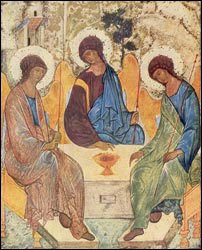
The Holy Trinity

With Christmas so close, I thought I would take some time to comment on the hope and grace we have in Jesus Christ. My friend Ben Felder wrote a great little article on the Holy Trinity on his blog, http://www.benlori.blogspot.com/. Ben, commenting on what Robert Jensen has written on the Trinity, "the Trinity is the scripture in a nutshell." What a statement. I think this is most clear in the movement of the Holy Trinity, facing in and moving out. The Holy Trinity, that is, Father, Son, and Spirit, faces in relationship with one another and moves out to effect the transforming grace in the world.

A relationship with the Other is most difinitively expressed vis a' vis, face to face. Not present or absent, but in the face to face. The Trinity faces in, the visage of each person of God facing the Wholly Other visage of each person of God. This is a model of relationship within the church. We must face each other, come together, be present to one another despite our absence. We must congregate, purposefully to model the Trinity (worship, fellowship, community). This is our calling to "Love the Lord your God with all your heart, and with all your soul, and with all your might." Deuteronomy 6:5 NRSV.

A relationship with the Other is fulfilled in the action beyond/ignighted by/necessitated by facing in. The Trinity does not stop at the mere facing in (expressed by some deistic models of God as well as a simple "unmoved mover" model), the Holy Trinity moves beyond him/herself. The Trinity moves out into the world to bring blessing, effect grace, and love in the perfect act of reconnecting God and man. In the same way, we must move out into the world, bringing blessing to the other, reflecting God's grace, and making disciples (compassion, disciple-making). This is our calling to "Love your neighbour as yourself." Leviticus 19:18.

By this, we can see that "the Trinity is scripture in a nutshell." To model the Trinity is the Great Commission!

Sunday, November 27, 2005

Back in Town


Julia and I are back from a short, but fun trip to our friends, Tim and Glenna, who live in Syracuse, KS. Syracuse is a very small town, but we had an extremely restful and relaxing time. Wednesday and Thursday, Thanksgiving, we did nothing. I mean, we did something, but that something, was wonderfully refreshing. Sure we ate, but mainly we chatted and watched television, or read. Friday we drove over to Pueblo, Co for a bit of shopping on what folks now call "Black Friday." We did not get up and stand in line at the Wal-Mart or wherever at 4 in the morning. But we did go to a mall for the first time in about 2 years. Anyway, I hope everyone had a great Thanksgiving.