Tuesday, September 12, 2006

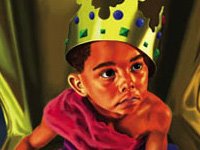
A Boy King


James Burke writes in his book The Day the Universe Changed:

"You are what you know. Fifteenth-century Europeans ‘knew’ that the sky was made of closed concentric crystal spheres, rotating around a central earth and carrying the stars and planets. That ‘knowledge’ structured everything they did and thought, because it told them the truth. Then Galileo’s telescope changed the truth. As a result, a hundred years later everybody ‘knew’ that the universe was open and infinite, working like a giant clock. Architecture, music, literature, science, economics, art politics – everything – changed, mirroring the new view created by the change in the knowledge. . . . At any time in the past, people have held a view of the way the universe works which was for them similarly definitive, whether it was based on myths or research. And at any time, that view they held was sooner or later altered by changes in the body of knowledge."

Now for an 8 year old boy named Josiah, it was not much different. For Josiah, Galileo’s telescope came from the mouth of one of King Amon’s messengers who carried the horrifying news that Josiah’s father, the king was dead. A political assassin was responsible for Josiah’s fatherless nights. There would be no more tucking in; no more nightly prayer with his father; no more songs just before lights out. Josiah’s universe changed. But with this terrible news that his father was dead, came also a crown. And for an eight-year old boy who’s mind should be on his next little league game is this was a huge deal. This boy’s world was turned on its ear and he was only eight.

Josiah was crowned king of a nation at the age of eight. I want each of you to think back to when you were eight, and think of who you were, what you did, what was important to you. I was probably a bit different than you. By the time I was eight, I had been Superman, a member of an elite paramilitary group called the A-Team, the next 007 agent, otherwise known as 008, and I could turn myself invisible by just wearing my jacket backward. At eight, I would sneak time to watch MTV and Nickelodeon. At eight girls were still kind of disgusting.

It was very different for Josiah. At eight he was the king of a nation. At eight he recognized the importance to live for God even though his father, Amon, and grandfather, Menasseh, only modeled idolatry for the young king. Josiah’s convictions had already been formed. But his knowledge of the universe changed drastically and he was only eight.

Okay, okay, you get it already. You know where I’m going with this. You’ve heard it before. Children are important to God. We know that God has hidden the things of his Kingdom “from the wise and learned, and revealed them to little children” (Matthew 11:25). But do you get that you must become like little ones to enter the Kingdom of God? Do you really see that?

I say certain things as I minister to children and families. Julia calls them Evanisms. You will hear me say, “Children are not the future of the church. Children are to be expected to be and accepted as the church here and now.” You will also hear me say, “Children, just like adults, are called to be whole and holy citizens of the Kingdom of God with all the rights and privileges therein.” These things are not easy to grasp, and to our sensibilities they are just as radical as Galileo’s telescope.

Josiah grew up differently than his father and grandfather. He feared the Lord. He worshiped God and even began to rebuild the temple of the Lord. He did these things because he knew it was right. When Helkiah brought the lost sermons of Moses to Josiah and they were read aloud to him, the universe changed again. When Josiah heard the words of Deuteronomy, “Love the Lord your God with all of your heart and soul and mind” he tore his clothes. He went to the prophet of Israel, Huldah, and she told him that while he caught the eye of the Lord and would not be punished, God would still allow Judah to be exiled because they did not adhere to his commandments. This news of Judah’s destruction did not stop Josiah. He mounted his men and rode throughout the country destroying the statues of Baal and Asherah, rebuilding the synagogues, celebrating Passover once again, and putting nothing before God. For Josiah, God was not merely first, God was only! The revival of Judah came because the boy-king Josiah got it. He understood his role as a citizen in God’s Kingdom.

All of this from a king crowned at the age of eight, a child to whom the mystery of the Kingdom of God was revealed. The Bible calls him Israel’s greatest king. He brought Galileo’s telescope. He made revival possible. People once again knew that there were to be no other gods before God. God is not God first, he is God only.

I believe revival will come today when we begin to accept children as proper citizens of God’s Kingdom, when we begin to expect them to make disciples, baptizing them in the name of the Father, Son, and Holy Spirit. Revival will sweep this world when children are accepted as our brothers and sisters in Christ.

As pastor to children and their families, I will partner with parents, casting vision, equipping, encouraging, resourcing, building relationships with you so that we can minister to the children of Dayton, Oh. Together we will model for them what it means to be citizens of the Kingdom of God But know this, I cannot not do it alone. It can only be done in partnership. Perhaps this for you is Galileo’s telescope, changing the way you view the church. God has called us to his purpose. We must become like little children to enter into his Kingdom.

Thursday, August 31, 2006

A Terrible, Horrible, No Good, Very Bad Day . . . Part 2


We finally arrived in Dayton to look at our new house. We hadn't signed a lease agreement or made any formal agreement yet, but we were only four days out from actually moving in and were a little concerned about where we would live. The neighborhood was urban and we liked that. As we pulled up to the curb and saw our house, we were pleased. It was definitely a big place.

The gray brick exterior stood out. The front yard was small and parking was accessed through the alley in back. Then we were taken inside. We were greeted by two very contrasting things: the horrifying stench of cat urine and beautiful refinished hardwood floors. But that was it. The two telephone jacks we found had been ripped out of the wall. The kitchen was floored in an old parque vinyl covering of some sort. The refridgerator didn't have any handles and the were three cabinets. This was not going well. The basement was unpresentable. The carpet upstairs was old, used and had not been layed, but was placed. The bathroom needed a lot of work. We discovered with the rent and utilities the cost would have exceded what it would've cost to live closer to the church. Perhaps I have not done the shambled state justice. It was bad, really bad. And then, we didn't have a home to live in.

We had originally planned to go back to Decatur, Il that night, but we were confronted with the prospect of homelessness. So, we decided to stay. We spent the evening with a realtor, a member of our church, who graciously showed us other options. That night we stayed at the local Holiday Inn Express. And the next morning we toured five or six apartment complexes. We finally settled on a three bedroom townhouse in a complex immediately next to the church. Even after finding the place, we were not sure until Sunday that we would actually have a place to live.

Now, of course, the day doesn't feel so bad. We are moved in, it is smaller than our house, and we will have to rid our selves of some things, but that's not necessarily a bad thing. Anyway, things are beginning to settle.

Friday, August 25, 2006

A Terrible, Horrible, No Good, Very Bad Day . . . Part 1


We heard something hit under the wheel well and didn't stop to check it. Now, it was nothing major. It didn't sound like the lug studs snapping off, the wheel throwing the end of the stud still attached to the nut, up under the car. No, we know what that sounds like (that's another story altogether). This was more like the sound of a piece of some truckers steel belt radial: a soft, rubber-padded thud, but a thud nonetheless. Julia was driving with the cruise control engaged. Just a mile or so down the road she complained about the wind and its subtle tug on the car.

We were in the process of moving from the panhandled of Oklahoma where the gale force winds were 25-70 mph and constant. In Indiana, about 30 miles from Indianapolis, I doubted it was usually that windy. A small, white pick-up truck pulled around us to pass. A minute or so went by and the truck hadn't passed. Julia made a comment about people who didn't use their cruise controls on the freeway. The truck still hadn't passed.

After a few minutes Julia became annoyed, perhaps frustrated with the odd behavior of the pick-up truck driver. Now he was making gestures and such. That's when it happened. I looked over to see if there was something wrong when a muffled boom came from the rear driver's side of the Jeep. Julia attacked the brakes sending the full 44 oz. Coke I held in my lap (as if I needed that much anyway) tumbling to the floor. Julia pulled over without any further danger to us, however the carpet on the passenger's side will need a good shampooing. The truck that was acting so suspicious immediately pulled over, the driver jumped out, and ran back toward our Jeep. I got out, checked the tire to find it completely blown with massive damage from sidewall to surface one third of the way around the tire, and then walked to meet the (as we now realized) kind stranger.

The man approached me, telling me that he tried to warn me that the tire was extremely low. He flashed his headlights, waved his arms, all trying to get our attention. I told him thank you and that I was sorry we didn't understand him (although I didn't tell him that while driving we though he was some sort of loon). He asked if we need him to call anyone. I told him that it wasn't necessary, that I would just put the spare on and get the tire repaired in Indianapolis. He waved goodbye and that was the last we saw of him.

We drove to a Sam's Club in Indianapolis, bought a new tire to replace the blown tire, and we were finally on our way again. We recently had serious issues with a warped rim, broken lug studs, and a 3 day stay in a very small town in Southern Kansas. The fact that Sam's Club fixed the tire in less than an hour was very joyous indeed. However, this was only the beginning. This was only part 1 of a "Terrible, Horrible, No Good, Very Bad Day."

Sunday, August 13, 2006

WonderBread


John 6:35-51

I was afraid I was going to sound a bit repetitive, not just because I assumed someone else would be doing the homily this week, and would be able to give a different perspective on this passage, but because the passage we read today from John 6 is simply a continuation of the sermon we were listening to as Jesus spoke in the synagogue last week. I thought – what else do we have to learn from this?

I see I was wrong. Even though it seems like he keeps saying the same thing over and over again.

He keeps saying a very strange and dangerous thing, “I am the bread of life,” . . . The crowd is skeptical already, looking for a plausable explanation as to why and how he can make these claims. We already saw that when he said these things last week; Jesus was in fact suggesting that faith is based not on a set of beliefs, concepts, propositions, but on a person itself. And more on this now, we come to “The Sermon, Part II: Up to and Over the Edge.”

Jesus doesn’t just make up these claims of divine Sonship. He draws on the richest and deepest memories of the Jews to connect himself to the expectations and assumptions they had already made. More like, he picks the scab of exile, separation, frustration and begins to clean out an old wound. He brings up their desert wandering: 40 years of grumbling, mumbling under their breath, and always looking sideways for the next big thing. Remember God in the wilderness -- your lack of faith and God’s relentless provision and the inevitable consequences of sin? These wanderers were literally fed every single day with bread from heaven, but they did not ever see the promised land.

Jesus draws a direct parallel between who he is and the God of manna and quail, the God of water from a rock, the very IAM of Moses’ burning bush. They should know him; they should recognize him as their own. Their beloved Scriptures point to him, and they have embraced His Laws.

Yet His I AM’s literally begin to “flesh-out” the veiled, terrible face of Yahweh. Ordinary earthy images that somehow transform into eternal reality.
I AM . . . the light of the world.
I AM . . . the gate for the sheep.
I AM . . . the good shepherd.
I AM . . . the resurrection and the life.
I AM . . . the true vine.
and of course,
I AM . . . the bread of life.

Do you notice their reaction? We might as well be back in Exodus – and John goes right along with this – for he says the crowd complained. That’s right – in political exile, still wandering -- their God comes to them face to face, and just like in the days of old, they murmur under their breath, grumble quietly to their closest neighbor.

But Jesus doesn’t just stop there. He’s taking them to the edge. Now it is time to push them over. “Very truly, I tell you, whoever believes has eternal life.” Again, “I am the bread of life.”

Now a quick aside regarding this word “believe.” We use this verse a lot, or at least something close to it, when we “present the gospel,” to a seeker. Our A,B,C’s are as easy as: Admit you’ve sinned, Believe in Jesus Christ, and Confess Him as your Savior. Simple. Easy. Viola!

But hopefully when we use this tool in bringing our neighbors to Christ, as when Christ himself said it here, we are not just speaking of a ubiquitous assent or indisputable claim. Belief is actually more than just saying you think it’s true or think it exists. I can believe in ghosts. They still may not exist. Cogito ergo sum – chucked out the window.

Perhaps belief and eternal life is not so much about “think it’s true and because you believe, you will last forever” (thank you, Chicago). Eternal life, sure, it’s a reward. But it’s not so much about that particular pattern of cause and effect – in other words, God saying, “I’ll scratch your terms of existence if you scratch mine,” -- as it is the inherent result of being in understanding, deep intimate knowledge of Jesus Christ himself. The Giver and Sustainer of Life.

The fact that we would experience eternal life is only possible because it is inextricably linked and rooted in who Jesus is.


Now here is where I think we’ve messed it up.

What if we’ve got it all wrong? What if where we’re going, what we’ve always done and have always thought we were supposed to do is completely wrong. Off base. Out in left field. Wrong.

What if what we’re supposed to be doing and what we’re supposed to be about is what we’ve unwittingly been working against. For all our good intentions, we’ve missed the point . . . we’re wandering in the desert, expecting the promised land, looking and making up signs to point us to it, and in the end we may never reach it.

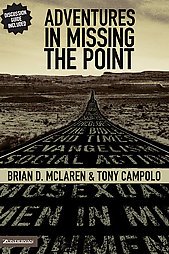
I wonder this aloud, and in relation to Jesus’ claims about our belief and living forever and being “bread,” because I’ve been reading a very interesting and probably dangerous book, Adventures in Missing the Point by Tony Campolo and Brian McClaren.

They talk about the Kingdom of God, which interestingly is what defined Jesus’ earthly ministry. Jesus’ preaching was not all fire and brimstone, though he warned of being cast out into the darkness. His teaching was not a neat outline articulating the “Ten Steps to Eternal Life,” though he spoke of his going to prepare a place. His real message was quite straightforward, “The Kingdom of God is at hand.”

It is HERE. And it’s about life NOW. We need not look anywhere else.

So salvation, McClaren and Campolo maintain, is not so much about being bailed out of any particular political exile, or for that matter, being deterred from morally repugnant behavior. But neither did salvation mean being tractor-beamed up into a celestial utopian bliss never to deal with the dirty, smelly, indiscreet world again. Instead, salvation was literally being rescued from the constant oppression of any and all of these corrupt circumstances to live the kind of life God created us to live.

Then McClaren actually suggests,

“If our theologies make us focus on the eternal and the individual (i.e. getting my soul into heaven) so that we avoid God’s concern for the historic and the global (i.e. God’s will being done on earth as well as in heaven), then the more people we win over to our theologies the fewer people will care about God’s world here and now.”
”The more converts we make, the worse the world will become.”

“If God really cares about justice in this world here and now, and if we are converting people away from the concern, then we are working against God. We could inadvertently become enemies of God’s wishes.”

Now I am not saying that we don’t have something to look forward to – we certainly await our reigning King to return in this already-not yet Kingdom. But when he returns, he’s not throwing this world away.

He’s proved this through His Incarnation – simply by becoming man, our God proved that flesh and spirit are no longer, or maybe never were, at war. He did not come for us to merely believe with our minds, and in gaining a special otherworldly knowledge about him, He himself could never be grasped, embraced . . . eaten.

For Jesus says, “Whoever eats of this bread will live forever; and the bread that I will give for the life of the world is my flesh.”

Salvation through Jesus Christ is real – spread through every substance, compound, molecule, and atom of Creation, for Christ’s personal sacrifice was neither a mental game nor a mystical battle. His sacrifice was a sacrifice of sarx – flesh – you know, the earthy, prone, vulnerable – that stuff we all have to deal with too. Jesus physically died upon a cross, while ribs cracked under his own weight, and blood poured from gaping wounds in his hands and feet, and water poured from his side.

This is our Bread.

This is our Daily Bread.

The Bread we ask for through gritted teeth. Or crossed fingers. Or faraway looks. Someday everything will be alright . . . when we all get to heaven.

But thank God, it’s not when all the bills are paid, or when the school year is finally over, or when Vacation Bible School is finished. Christ did not tell us to wait. He didn’t wrap us up in white robes and lock us in a little room to hold hands and drink some funky Kool-Aid – and for goodness sakes, get up here as fast as you can. He told us to go. Go into the world. Go and make disciples and baptize them into the Kingdom. He wanted us to Live.

Here, today, in celebrating the elements of Christ’s Body around the Table, and as Christ’s Body in the world, we usher in the Kingdom of God. As citizens of this Kingdom seeking to do his explicit will, we demonstrate belief in his Son for we also incarnate the very Spirit of Christ that is present and active in THIS world. This is more than a foretaste of the day when Christ does return to a new heaven and new earth.

So, what is our grumbling? For bread we believe we have never received.

We get to taste the Kingdom.

Live as though we believe. Believe that Jesus is Lord. He is Lord of Creation and Lord of our lives.

Let our ordinary lives reflect our eternal lives, the eternal life that we enjoy even today.

Monday, August 07, 2006

Paper Doll Funerals


Janice Hancock was just a little southern girl in Conway, Arkansas who loved to play with paper dolls. Everyday she would dress them up and take care of them. She would play with them and put them away when she was done. Those paper dolls were some of her favorite toys and good friends for a little girl.

Janice had a cousin who would come to play. His name was Hollis Williams. Hollis was a serious child with a fascination for ritual. Every day, Janice would pull out her paper dolls, dress them, and play with them. When Hollis would visit he would play with her and her paper dolls. Sometimes, her paper dolls would get sick and on the rare occasion those sick paper dolls just wouldn't pull through, Hollis would be ready with Bible in hand to perform the funeral. A small, private family service attended by only that little southern girl, a boy priest, and a few other paper dolls.

Janice is my mother. This was Conway, Arkansas in the 1940s. She told me that even as a little boy, Hollis loved ritual and liturgy. He grew up to become a priest in the Episcopal church. She doesn't know where he is now, but she just knew that's what he would end up doing.

Even now, I see the spiritual lives of children take on Kingdom of God qualities. I see kids who take the candy that they have and share it with other kids. Many times they count out the number of pieces so that eveyone has some. Sometimes, I see kids ask others if they are all right, you know, when they fall and have hurt themselves. I see a little boy who notices his friend pray a prayer of beginning, the start of a journey perhaps, or even his next step in the journey to wholeness and holiness.

Children have a heart for the spiritual. Not always, like adults, do they make the decisions that honor God and others. Those are the times they fail to mirror the Creator and instead mirror parents who they've seen talk abusively to each other or something they've seen on television. Notwithstanding, they are sensitive to the heart of God, moreso, certainly than adults.

I see in a boy who finds joy and comfort in meaningful ritual or a girl who takes part in the same, the heart and voice and mind of God. Take comfort in a paper doll funeral, for our hope is in the Resurrection. Take joy in the faith of a child, because the Kingdom of God belongs to them.

Saturday, July 29, 2006

Soulshine Is Better Than Sunshine . . .


Last night, or rather early this morning, Julia and I walked in the American Cancer Society's Relay for Life. Almost a year ago my brother in-law died because of cancer and yesterday Julia's father was diagnosed with cancer. We thought it would be good to participate in the walk. It was a good night and there were several people there that we knew from town and from the church. We walked with our good friend Steve Lehew whose nephew died a while back and whose niece, just a few weeks after her brother died, was diagnosed with cancer.

I bring this up because I was listening to one of my very favorite songs "Soulshine" by the Allman Brothers Band. This song was played at Don's, my brother in-law, memorial celebration. Everytime I hear this song I smile and sometimes I cry.

"Life can take the strongest man and make him feel so alone . . . I think back to what by daddy said, he said it's always darkest before the dawn. Gotta let your soul shine, it's better than sun shine, it's better than moonshine, and it's damn sure better than rain. Oh, the people don't mind. We all get this way sometimes. Gotta let your soul shine, shine to the break of day."

I've been thinking and writing about John 6, just after Jesus feeds the five thousand with a boys lunch. Evening had come and the disciples crossed the lake. They had trouble because the wind picked up and it was dark. They had rowed a few miles out and that's when they saw him and were terrified, scared out of their minds. It's always darkest just before the dawn. It was of course Jesus they saw, walking on the water, toward the boat. No wonder they were so frightened. Jesus said to them, "It is I; do not be afraid." Then something else amazing happened. The disciples wanted to get Jesus into the boat, but immediately the boat reached the land where they were headed.

We walked from 11:00 until almost 1:00 am. Certainly not the darkest time of the night, especially with the football stadium's lights at full blast. It was a good time for us. A real means of grace as we thought of Don and Julia's dad. God is a gracious God and he is a faithful deliverer.

Wednesday, July 26, 2006

And Now For Something Completely Different


I realized that our blogs had been a bit more serious than expected recently. With that in mind, today's topic is the Candy Bar. I am going to talk about some candy bars, rate and rank a few of my favorites and maybe others can comment with a top three favorite candy bar list.

Now, I have two friends who lived in Europe for a while with their families and they swear that chocolate from the United States is horrible compared to their European, particularly Swiss, counterparts. They say it is as though chocolate here in the U.S. is watered down compared to other world chocolates. However here, we are not going to discuss chocolate bars per se; we are going to discuss candy bars and chocolate only as it pertains to the specific mentioned bars. Well, let's get started!

First, I would like to mention my very favorite candy bars. This candy bar hails from Australia/New Zealand. The Violet Crumble, made by Nestle now, is a "honey comb" center covered in chocolate. This ambrosia candy bar is not to be confused with it's lesser Cadbury made rival the Crunchie. While both are similarly made and styled, the Violet Crumble has this sort of melt-in-your-mouth texture that tastes and feels fresher than the Crunchie (Cadbury 1939). Just to give an idea of my feelings for Violet Crumble, if I were in the woods and my left arm were caught in a bear trap and there were a Violet Crumble just out of reach, I would naw off my left arm in order to reach that miracle of a candy bar. You can purchase this candy bar at some specialty candy stores as well as Jason's Deli. There you have numero uno in the candy bar list.

Second place goes to another Nestle product. This bar has recently reemerged and because of the popularity of Charlie and the Chocolate Factory. It is Nestle owned Willy Wonka's Wonka Bar. The Wonka Bar is Wonka milk chocolate (reminds me a bit of Tobler chocolate because of the texture and chew quality) with crumbled up graham crackers. It is the perfect candy bar to eat while playing board games. I don't know why, but I enjoy them very much while playing Settlers of Catan. You can purchase this bar at some convenient stores, movie rental counters, and the occasional grocer.

The final candy bar on my list to round off the top three is a Cadbury product. Caramello has been one of my favorite bars since I was a kid. I can't tell you how many Caramellos and Mt. Dews I've had. All that sweet caramel and chocolate can't be bad for you! This is also a good board game candy bar, although I'd be kidding myself if I didn't say all three of these candy bars are good with a board game and a glass of milk (whole, of course).

There you have it, the best three candy bars in the history of candy: Violet Crumble, Wonka Bar, Caramello. What do you all have?

Monday, July 24, 2006

Dayton, Oh


It's official. Julia and I have accepted ministry positions at Parkview Church of the Nazarene in Dayton, Oh. We are very excited and yet sad. We are looking forward to working with Rev. Dave Ringhiser and being a part of his team. However, we know we are leaving behind a church and folks we love very much. We do feel God's direction in this decision. Please be praying for us and for our churches during this time of transition.

Tuesday, July 18, 2006

Clarity In the Arms of Christ

I spent some time with those wonderful Irish Jesuits at Sacred Space today. They reminded me that in all of this decision making, all of the prayer and conversation, all of all of it, I had not yet really taken the time to rest my whole self in Jesus' lap and just listen. It is about time to really listen, don't you think?

Monday, July 17, 2006

Where Is God in Decisions?

This question has been plaguing me for some time now. When I talk to great men and women of faith and hear of the clarity with which God speaks to them, guides them with what seems to be an iron clad control, I can't help but feel a bit jealous. It is different for those of us who espouse the openness of God. We believe that God knows all that is possible for him to know, which of course leaves out the future. As we have free will, the future cannot possibly exist without it being decided and thus exempting free will. What is left is the God who has determined what he will do in the future, leaving open the idea that he might change his mind or the possibility of folks standing in the way of that will. Thus, God in his choiced goodness, gives us direction that can be altered by our choice or others.

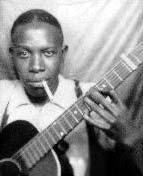
That is where we stand today, trying to discern what God might have for us, knowing that he might have a choice between two or more valid options. How do we as Open Theists pray for God's will and at the same time feel honored by his redemption of bad situations and recognize his deliverance of us from situations gone bad? I have asked for clarity, peace, and always sought God's will. This has meant, for me, giving up things that I would have loved to do, such as the academy, for something that I have grown to love, pastoring. Now, I wouldn't trade pastoring for anything. However, we stand at a crossroads and I have no guitar and there is no devil there to whom I can trade my soul for guitar playing skills (nor would I want to, I just wanted to point out that I have mundane knowledge of Robert Johnson and his bluesy mythology).

What we really need is focus and clarity. We are praying that God's will be done. Please pray with and for us.

Sunday, June 25, 2006

The God Who Touches Us, The God Who Is Touched By Us

In thinking about next Sunday's (Proper 8) lectionary Gospel text (Mark 5:21-43, Episcopal reading) I see, or rather begin to see the real extent of the grace of God. In this scripture, Jarius comes to Jesus to ask if he will touch his deathly ill daughter and make her better. Jesus agrees and walks to his house. On the way, a woman who has suffered from hemorrhages for twelve years touches the hem of Jesus' cloak so that she may be healed. She is; Jesus feels it; Jesus confronts the woman. The woman falls before Jesus and explains everything and Jesus tells her that her faith has healed her. As Jesus continues to Jarius' house a messenger meets Jarius and tells him not to waist anymore of Jesus' time as Jarius' daughter has died. Jesus still insists on seeing her, tells the mourners that she is not dead just sleeping, whereupon they laugh at him. Jesus goes to the girl's room, touches her hand, and tells her to get up. She gets up, everyone is amazed, and Jesus tells them to keep their mouths shut.

There it is more or less. However, there is, to me, a great revelation of God that I have lingered on for years in this passage. It is the touch. There are two touches of significance here. There is the touch of the woman who has bled for twelve years, and there is the touch of Jesus that raises the dead girl. The touch is something that perhaps we glaze over as we read this story. We've heard it enough anyway and there are surely more important things to focus on, why would Jarius, a Jewish leader, seek Jesus out for help, or the faith of the woman versus the faithless mourners. However, I focus on the touch in this story. It is the thing that moves me.

Touch is a sense that makes sense to a sensory people whose lives need sense. Think of the paternal or maternal touch that can be so comforting for some, yet so abusive for others. Think of the excitement of the touch of the first hand you held. I think I was so excited that I had to pee. Think of the first kiss, a touch still, and the rush of adrenaline and hormones that can't possibly explain all there is to feel in a first kiss. I remember the first time I brushed skin with my wife (of course then she wasn't my wife) and every time I think about it I smile. Think about the first punch you threw, or took. Think of the last time a loved one died and a friend or pastor put their hand on your shoulder or hugged you. Think of what touch really means. It is one fifth of all that we sense and when it comes to sense the parts are just as great as the sum.

Now, think of God in the flesh. In Christ we see God/Man. Christ is both fully God and fully man. He was born a baby, wrapped in strips of cloth, and laid in a trough out of which cows eat. He grew up, died as man, was risen as man, and ascended to be at the right hand of God the Father almighty as man. But this was no Greco-Roman half god, half man, Hercules. Jesus is the real deal. He, while fully man, is also fully God, present at creation, fulfillment of the law, God with us.

This is my dilemma with the passage. God touches the little girl to raise her from the dead. He touches her and she is moved. God became man and touched people. People were changed because of it. It happens all through the Gospels. Jesus heals the sick, touches children, lepers, mother in-laws. It's amazing. God touches people and they respond by being moved, healed, transformed. This is heresy. Certainly God would not debase himself by touching people. Yet he does. And people respond, all glory and honor be to God, they respond. God touches us.

If it ended there, all heaven would rejoice and all Earth would seek to be touched by God, but it does not end there. The bottom falls out. Logic is shattered. Economies spill like milk from a screaming child's glass. The world is turned on its ear as God allows the unthinkable. This story is not merely about God touching people. It is also about people touching God. This is the part of the story that could offend those who stand so firm in their belief of an ineffable, immutable, self-sufficient, invulnerable, changeless (oh, did I already say that) God. If you believe in such a deity, please do not continue reading. On second thought, go ahead, your comments will be fun to read.

The crowd pushed in on Jesus. They were uncomfortably close and someone wreaked of body odor. Who is that? The static electricity of excitement about Jesus and what he would do about Jarius' daughter built like leather soles and a wool sweater on thick pile carpet. Something was going to pop at any moment. This was her chance. She'd been bleeding for twelve years and had heard what Jesus could do, but people were too close for her to get to him. She thought that if she could just touch, even the hem of his cloak, the bleeding would stop. She leaned over at just the right time when two people had stepped ahead. She reached out and touched. All hell broke loose. Jesus just stopped. The crowd couldn't stop in time and fumbled getting control of itself. Three people fell and were embarrassed. Jesus knew he'd been touched. He'd felt his power move out in blessing. He was affected. He was moved and the woman was healed. She told him what had happened and he told her that her faith had healed her. But it was too late. History was changed forever and God had been touched by people. The unmoved mover was suddenly moved.

God was touched by a person and not just any person . . . A woman and not just any woman . . . An unclean woman. Suddenly, the ineffable God doesn't seem so far away. The unaffected, self-sufficient God isn't so ivory tower any more. It seems when God became man, he really did get off his high horse. This is why this passage affects me so much. God not only touches us and we are changed forever, but God is touched by us and he is changed forever. In YHWY the Transcendent and Imminent are One. We are invited by God to be touched by God and to touch God. What an invitation. I accept. . . With everything that I am, with everything that God will make me.

The Bee Jays


The sky was clear and the sun shone through the gap in the grand stands. The smell of low cut grass and ball park franks wafted. We were sitting in the shade behind home plate. Louisiana Tech's Dylan Mosley was pitching and I hadn't been to a real ball park in almost two years. The last (non little league) game I had attended was at Kaufman stadium in Kansas City to watch the Royals lose to some or for that matter any other team in the MLB. This, however, was not Major League Baseball. This was the Jay Hawk league.

The Jay Hawk league is a semi-pro league touting such teams as the Liberal Bee Jays, the Southwest Slashers (Joplin), Hays Larks, and others. This night, it was the Bee Jays vs. the Slashers and would end in a close loss for Liberal. I found myself cheering for a team that had been around for 50 years. The Bee Jays solicit local corporate "buy outs" for each game so they can offer free entrance. The Bee Jays were named for American League founder Ban Johnson who offered good "clean" fun and low ticket prices for their fans.

It was a truly fun evening with friends, so fun that we returned for the double header on Saturday. The Bee Jays split the double header with the Southwest Slashers and I'm a fan for life. So take me out to the ball game . . .

Tuesday, June 13, 2006

It's Been Too Long


Almost a month goes by without a word. There's been a week long class with too much reading, Julia gone a week without me, and last week I caught up to her and spent a week on vacation. What a glorious, loud (after all we were with my family), crazy week it was. I took the train and met Julia and her parents in Galesburg, IL. I had never ridden the train before, though they have. It was uncomfortable overnight withougt a real pillow and blanket, but all in all, not a bad experience. It was good to go to a water park with two of my nephews; I really wish everyone could've gone, but alas, there was work and fear of water and stuff they'd rather do. It was good to see all of my nephews, though. I wish we lived closer.

Julia and I did discover something. It is a truth. It is a fact within time that takes on both subject and object in a balancing act that is guarded by "good" and communicated by "beauty." It is right up there with one truth that my brother-in-law taught me, "Life's too short for cheap toilet paper." It is the fact that one does, in fact, need a vacation from vacation. We were exhausted and so (write this on something more permanent than a blog) we took an extra night and got a hotel in Tulsa, Ok. That's right, spent money we didn't have to make sure we weren't so tired the next day, and it worked.

We arrived at about 7:00 pm in Tulsa and ordered pizza, hot tubbed, watched television, and hung out. The next morning we got up, had a huge breakfast, and went home. It worked. Imagine that. So, this will be our vacation practice from now on in order to ensure a vacation from a vacation. Amen.

Wednesday, May 17, 2006

Something Called Pioneer Days


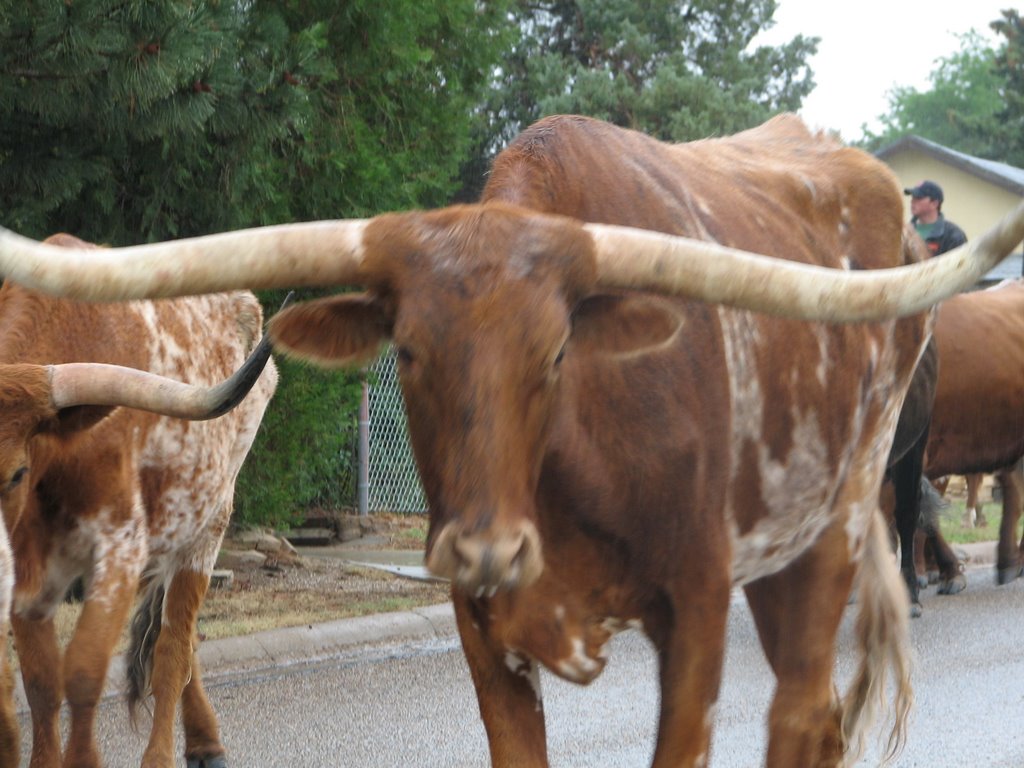
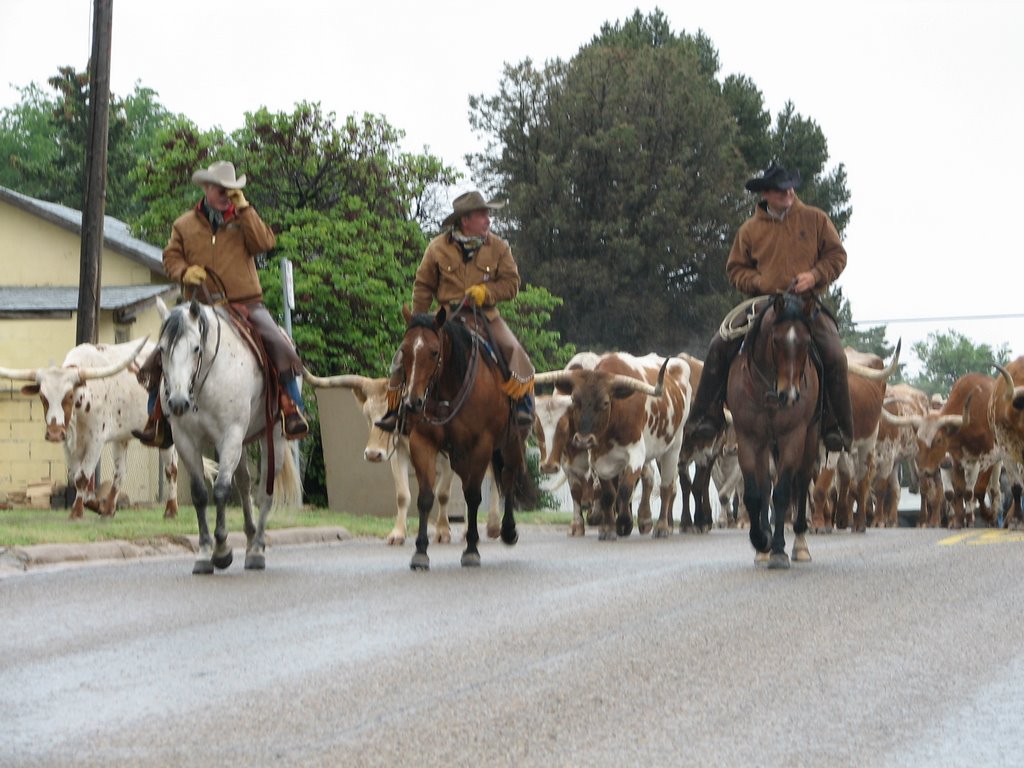
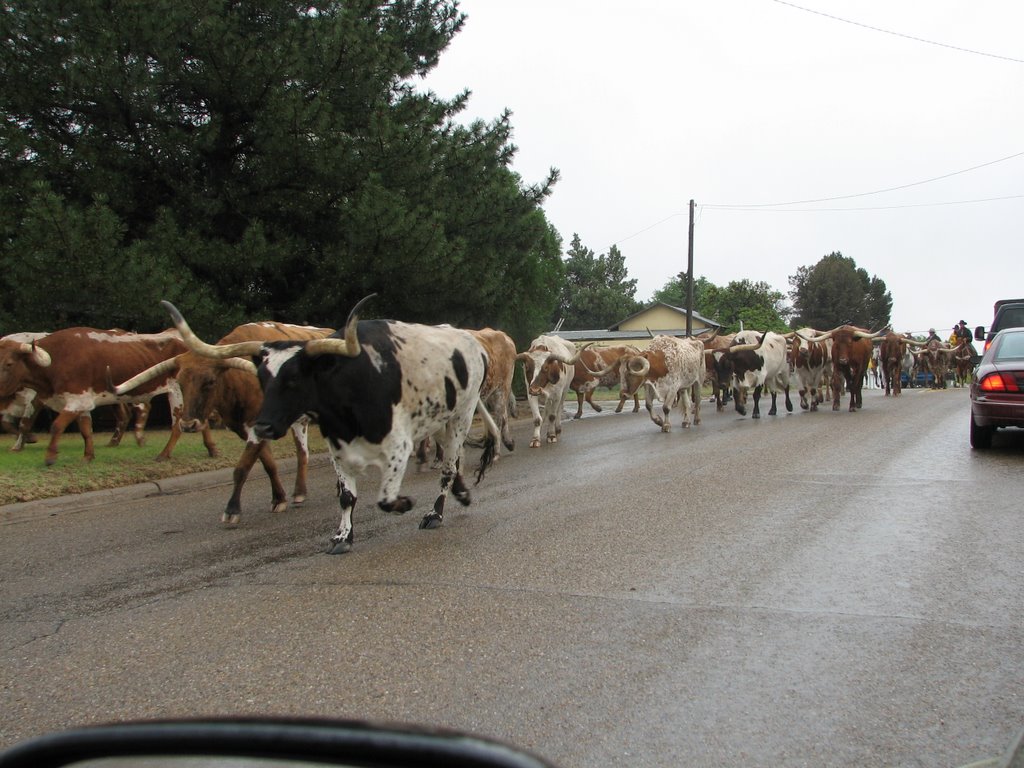
Guymon captures (and perhaps holds hostage) its "No Man's Land" identity in a celebration called Pioneer Days. There's a Dodge Rodeo, carnival, craft fair, and a parade. Now this might sound innocent enough, but there's something about the parade that everyone should know. This is not a normal sort of thing that happens at every parade, in fact it is not just for mere knowledge that I'm telling you all this. It is so that you will lock up your children, cover their eyes and don't stand too close to the road. For that matter, do not even come out in public without the ability to ward off the greatest of fears. At any moment, something horrifying could happen. Protect those you love, because the longhorns are coming.

You see, someone, at some point in time thought it would be a good idea to drive several head of cattle through the downtown during the parade. Now, granted I can't speak of no incident of violence this has caused, but it frightens me nonetheless. I have included a few pictures so that those of you who do not know or have not been to Guymon may see the insanity that is a cattle drive through the streets.

Sunday, April 30, 2006

Flying the Coop


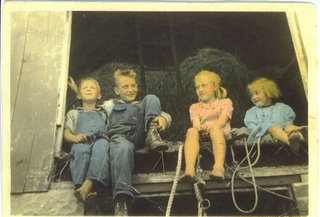
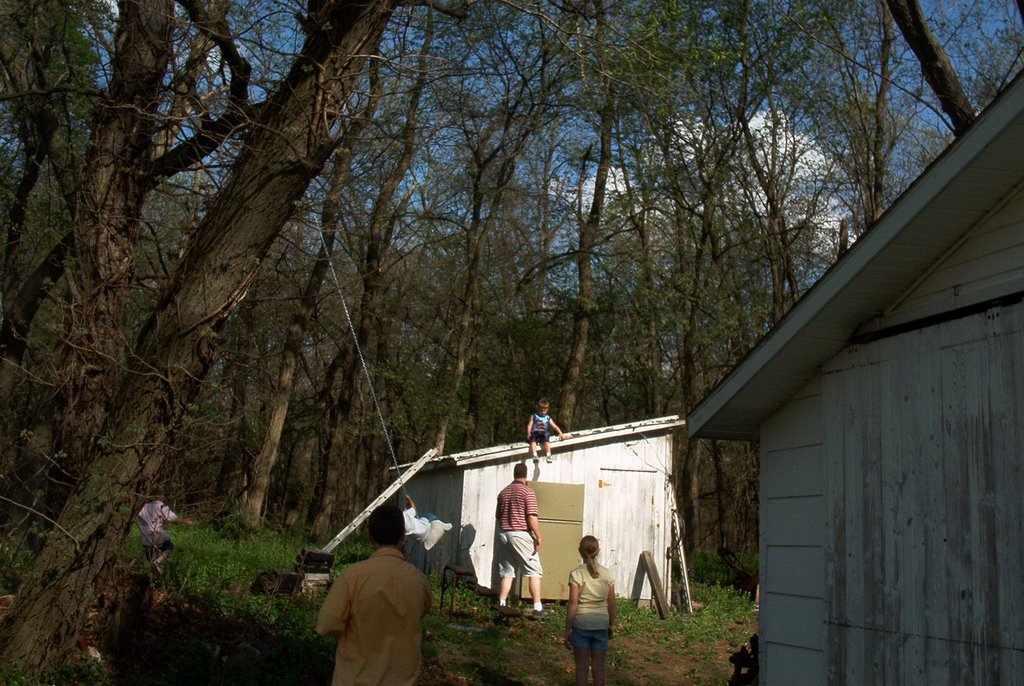
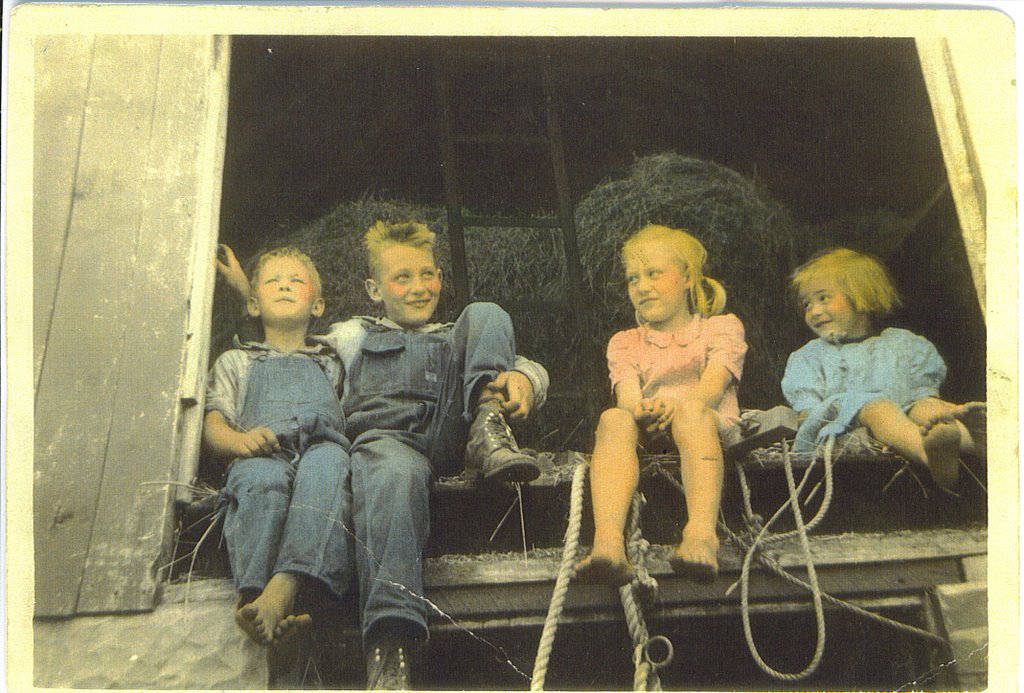
Since we're so far away from home these days, my Mom sends me pictures of family events we can't attend. I see these kids, 2-3 generations away from me, sons and daughters, in the same images and stories I've heard before. These are pictures of cousins leaping off the top of our chicken coop to ride the bag swing. Apparently the roof of the barn was not good enough. They moved the ladder to the coop, step off onto the refrigerator and swing away. Didn't Uncle Paul once try this once with an umbrella? I've seen U. Marvin, A. Bess, and A. Carol, swinging their blackened feet out of the hay mow -- 12+ feet above the ground.

We often reject ritual out-of-hand as meaningless or insignificant. Yet like any gift of grace, it is not so much a matter of what we are able to bring to it as it is discovering what is already and always there. These stories of flying off windmills and falling off tractors should be a part of these 4th and 5th generation sons and daughters as much as they are to our ancestors. They should not experience failing memories on our account.

The accomplishments and "relative" happiness of my family is not by accident. It is reinforced through the annual rituals of pinatas, name eggs, familiar photos, John Deere tractors, juicy watermelons.

Either our family is not afraid of heights or we find ourselves doing what families do best -- reliving and renewing the rituals and traditions that have shaped our lives for years, centuries, millenia. We are grounded in these things. They are what allow us to take the leaps of faith and ambition we need to fly.

Tuesday, April 25, 2006

Lines Written Over Dogs Barking Next Door

What are the sounds that move us from where we are to
where we would like to be, from here to who we want to be?
The sounds of honking horns and the only-in-a-city hums
remind us when we leave the city behind for something
not so city that there is such a thing as silence. Listen to
the click of a turned knob, the drip of water to drain.
The sounds of the wind in the winter and spring keep us
up on the memories and hope for the gentler, warmer,
a summer and early fall breeze.

The dogs next door bark at night, the sound of sirens, the cat
and dog breathing at the foot of the bed. They are all reminders
of life. Now awake thinking about the sounds of life, hear it,
the baby cries in church, and not everyone hears the real liturgy.
Some complain, disturbed and distracted, those also
bothered by other naturalnesses of children. That is not
the real sound heard. The baby cries again (sacramental)
during Word spoken from prophet, all of heaven rejoices,
I whisper, “Thanks be to God.”

Sunday, April 23, 2006

Hands and Feet


John 20:19-31
It was a crazy idea. That these very tiny little things -- invisible, in fact -- are the building blocks of the universe. Atoms! So tiny that they are indivisible. This would explain so many things, and yet because they are invisible there’s no way to prove it!

Believe it or not, this is what a crazy Greek man named Democritus conceived over 2400 years ago. Amazing that this man with no microscopes, no particle accelerators, no nano-technology, should come up with such an unbelievable idea. It would take 2000 years for such an idea to actually take hold in the minds of scientists and philosophers. But we believe it today . . . not so much because we’ve seen the atom ourselves, but because we’ve been told enough times and with the sufficient evidence to know that they exist.

Split one and we can cause the universe to collapse in on itself.

Evidence is really a hard thing. Evan and I love watching CSI – all three of them – Las Vegas, Miami, and New York. They pull little hairs out of carpet with tweezers, test white substances, boil bones. Juries convict on this stuff. It seems that the modern age does not require so much of a logical argument as much as it does good solid physical evidence. Stuff that we can see and touch and taste.

And we find our CSI’s at work here in this passage. For Thomas gives us a pretty understandable response when confronted with the suddenly fearless testimony of some previously very fearful disciples. Jesus had appeared to a shivering group of weary bleary followers. He showed them His hands and his side. He let them touch them. It still seemed like a dream. So when Thomas arrived, having missed the whole thing, you could understand his skepticism, right?

But now, poor Thomas, has been singled out. He sits right above Judas in the hierarchy of good disciples. We forget the disciples who were there were shown the same thing that Thomas demanded to see. Did they really ever have a faith any different than doubting Thomas?

Perhaps John is trying to tell us something here. Something besides a Jerry McGuire, “Show me the money!” kind of belief. A faith vomited up out of fear – fear of the Jews, fear of what is on the other side of the door, fear of death. They were all fearful. Thomas just said it out loud.

But Jesus’ response to Thomas, indeed to all the “believers,” was to let them poke into his side, and to stick their fingers into the holes and right out the other side. Jesus had the evidence that He was alive for those very people who had seen him die. Whether they should have needed it or not. It was His body itself, risen and glorified, that proclaimed the arrival of the Kingdom of God and redemption of all creation. They needed to see that because the world that is upside down had been turned right side up again.

Of course, Thomas’ response was the one of faith. He exclaims, “My Lord and my God!”

And Jesus does not deny him the recognition or the understanding.

An understanding not so much about what it was he was seeing but what it meant to see it.

For if Thomas hadn’t believed Jesus had been raised from the dead, how would he have believed the redemption fulfilled in this resurrection?

The commentator writes, “But belief itself comes from another source than evidence. It is a gift of God.”

Indeed, even our faith is something we can make up and work or will to ourselves. It is a gift we must receive only with fear and trembling. It is only formed in the moments we realize there is nothing else we can do to conjure it up, to squeeze it out. Only after enemies have left us defeated, and our efforts have left us worn out. When there nothing to have faith in . . .

I confess I am a doubter. Sometimes it’s not enough just to be told my God is faithful. That He does what He says He will do. I see His faithfulness in the lives of others – dreams fulfilled, plans carried out, redemption gained – I’m not always encouraged.

I read John’s words about why he wrote this story, “But these are written so that you may come to believe that Jesus is the Messiah, the Son of God, and that through believing you may have life in his name,” and I sense the struggle in these people.

I was not there on the hillside when Jesus fed the five thousand. I was not there when he calmed the storm. I was not there as he died on the cross. I did not wrap his body in strips of cloth. I did not hide in a dark room eluding the Jews. What evidence do I have that Jesus was and is who he says He is – the Son of God, the Son of Man, the Savior and Redeemer of the world?

I wonder where is this belief in my life? Where is God’s faithfulness? What is there to understand? Slogging through indecision, indifference, mediocrity, I’m looking for hands and feet, holes and marks and scars.

Science tells us that patterns of past behavior do not predict future behavior. Can this be true of God as well?

John writes to his beloved community and to us about what to do when we’re not seeing what we’re supposed to be believing.

And Jesus’ reproachful statement, “Have you believed because you have seen me? Blessed are those who have not seen and yet have come to believe,” is perhaps the beginning of that gift.

Our psalm concludes, “The fear of the LORD is the beginning of wisdom; all those who practice it have a good understanding.”

And in this Easter story we see certainly see fear. Fear of the Jews had lingered for days in the dark corners of their hiding places. They did not know what to believe. Jesus had told them what would happen, yet they still dreaded the knock on the door.

Jesus did not knock, but stood among them – literally breathing upon them his very presence. To touch his wounds meant no more fear and no more dealing. And doubting Thomas would be the first to proclaim what that presence meant – God with us.

He should be the one to remind us that it is the poor in spirit who inherit the Kingdom of God. Those who mourn will be comforted. Those who hunger who will be filled. Those who doubt will be met with scarred hands and wounded side.

What is understanding? Nothing that is not a gift of God. Do we come with faith to this Table? Should we, full of ourselves and our confident, nuanced, sophisticated faith? As if our faith is our backstage pass, our special clearance into these special rites and privileges.

Or may we come as Thomases with our eyes wide open in disbelief but our stomachs pained and growling ready to eat until we are filled?

I hope that we are not already there, that we might admit that we actually need Christ’s living breathing Spirit in our life and not our own hot air. Funny thing, Jesus knew then as He knows now, that we do need to get a grip on things sometimes. Let Him breathe upon us.

And today I invite you to this Table, to touch his broken body, and live again.

Julia, Word & Table Homily

Friday, April 21, 2006

Land Run of 1889


Today, I was trying to think of my favorite school memory. This is a difficult thing for me as I attended a great number of schools. It is not a spectacular memory, nor is it particularly favorable in any normal sense of the word. Perhaps favorite is not the word for it. Perhaps a better word is memorable. Anyway, there are two. In the third grade I was tossing my pencil end over end up into the air (while the teacher wasn't looking). The very last time I ever attempted this, ever, I caught the pencil with my left hand. Well, sort of. I actually caught it with my left ring finger. Okay, I caught it in my left ring finger. The tip of my pencil stuck gloriously into the tip of my left ring finger. To this day there is graphite still in that finger.

The other memorable moment of my school years was in the fifth grade, when the Space Shuttle Challenger exploded. I remember our school turned on the newly purchased room televisions and we watched the footage. It was disturbing. I remember feeling infinitely sorry for the students of the teacher who was on board.

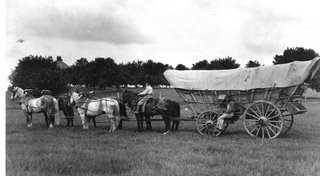
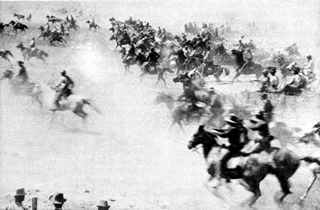
There you have it. My most memorable moments in school . . . That is until today. While I am not in primary school now, I can say that I experienced the very best of my primary school moments today. It was the 5th grade project on the Oklahoma Land Run of 1889. President Benjamin Harrison declared 2 million acres of government land open when Illinois rep. William Springer amended the Indian Appropriations Bill. Suddenly, those folks who wanted 150 acres of free land lined up and at noon (although, some were litigiously confused whether it was high noon or meridian noon) on April 22, 1889, the gun fired and they were off.

Much like this historical moment so many years ago, the 5th grade students, with on looking parents, grandparents, teachers, and a children's pastor, lined up their make-shift covered wagons and supplies. When the powder musket fired, the kids ran, wagon in tow, for a pre-placed stake of land. Once they had staked their "family" name on their land, they had to put up a tent, gather food and water, and then return to "town" for the deeds to their land.

I spoke with a few parents of the children involve who were both excited for the run and relieved that they no longer had to help with the building, cooking, and creation of things for the run. One parent, who had participated when she was in 5th grade said, "This was my favorite school memory." I turned to her and said, "It's mine too, now."

Tuesday, April 11, 2006

Betrayed

It was a hot night and Jesus had just done the unthinkable. He had washed the feet of his disciples. Now, understand that Jesus’, God with us, King of Glory, washed his own servant’s feet. I barely want to touch my own feet, much less anyone else’s feet. Yet, Jesus washes his disciples dirty, nasty feet on this hot night in the upper room. When he finished he said a few things about someone who would take some bread and betrayal. But who would betray Jesus? They’d all seen who Jesus really was.

Judas son of Simon Iscariot betrayed Christ. We’ve all heard the story. We’ve heard it from Sunday school teachers, in sermons, read it, and to some extent, we glaze right over it. We’ve heard the stories of Judas and his repulsion of Mary’s anointing of Jesus’ feet with expensive perfume. “Master, that stuff’s worth a fortune. We could sell it and give the money to the poor.” Hear Judas thinking, “I’m poor, after all. I sure could use the cash.” “Judas, don’t you get it.” Jesus said, “There’s always going to be poor folk and you’re always going to be poor. I won’t always be with you.” Judas’ hated to be publicly humiliated like that, especially in front of that whore, Mary.

We’ve heard the story of this night too. It was Judas who would betray his Lord. Jesus was upset and everyone there could see it in his face. It was pure pain, the weight-of-the-world-on-his-back kind of pain, to say it out loud. After all, Judas means “praised.” He was one of the twelve, not the new and improved twelve (Now With Mathias!), but the original formula, classic disciples. Jesus looked around at the twelve and said, rather laconically, “One of you is going to betray me.”

Instantly the whispered chatter spread around the room, Peter talking to Bartholomew, John and James exchanging the knowing and silent language of brotherhood, Mathew and Thaddeus exchanging questioning gestures with Phillip and Thomas. Judas, shifty eyed, looked at everyone and refused eye contact with anyone. The chatter, though, was broken by the Word of God, “The one to whom I give this crust of bread after I’ve dipped it.” Hmm, that’s funny that Jesus would still offer himself, as if giving the betrayer a second chance. There’s Jesus always the redeemer. Jesus dipped the bread into the wine and gave it to Judas. Judas took the wine soaked bread in his hand and the shadow of decision passed behind the pupils of his eyes.

Jesus said, “Whatever you are going to do, do it. Do it and get it over with. Quit putting off whatever decision you were going to make.” In that moment, I think of Joshua standing before the Israelites. If you are going to serve God, then serve him. If you are going to serve Baal, serve him, but choose already. Quit bouncing back and forth at your whim. Not one of the disciples around the table knew why Jesus said this to Judas. Some of them even thought he’d just needed to buy stuff they needed for the Passover feast, or that he needed to help some poor folk. Judas stood up, with the dripping, now soggy, piece of bread, and left. He made his choice. It was dark out.

But that is not the end of our scripture on this Holy Wednesday. It doesn’t stop there. It doesn’t stop with this dark and lonely moment in that upper room. After Judas had left, he spoke again, “Now you know who I am, who I really am. Now you know who God is. God’s glory will be on display for everyone to see.” He went on, “Listen. I am not going to be with you for much longer. You’re going to look for me, but I’m going places that you can’t go.”

And here it is. This is Christ’s answer to the betrayer. This is how God answers those who would act the part of supporter, friend, confidant and then turn around and hand him over to his enemies. This is how the Christ responds to the one who should have spoken for him, but instead took a measly penance of a bribe to have him killed. Jesus said, “Let me give you a new command: Love one another. No matter what happens. No matter who stands against you. No matter what others say about you. No matter which of your friends, spouses, children, bosses, co-workers speaks out against you. You are to love one another. Love each other just like I showed you how, just like I modeled it for you. You asked what love looks like? It is the washing of the feet, the laying down of one’s life.” Jesus looked at each one of the remaining disciples and said, “You know why I want you to love one another? Because when you love one another, like I love you, without expecting it in return, shameless love, scandalous love, when you do that everyone will know exactly whom you follow. They’ll know me when they see the love you have for each other.

As we look toward Good Friday, horribly, terribly Good Friday, I want you to remember to love one another. It’s not an easy thing, but it is the thing that marks you as whole and holy citizens of the Kingdom of God.

[this is based on the lectionary Gospel reading for Holy Wednesday, John 13:21-35]

Wednesday, March 22, 2006

Ketchup


A papa tomato, mama tomato, and a baby tomato were walking down the street. Baby tomato was a little slow and kept falling behind. Finally Papa tomato couldn't take it anymore, walked back to Baby tomato, and stomped on him squishing him completely. Papa tomato said, "Ketchup!"

It's true. I have not written here in a month. But here is my short, ketchup. I have been building a puppet set, remodeling a bathroom (completely), taking an online class (history and polity of the Church of the Nazarene), trying to keep from slumping into a deep depression, writing some poetry, maintaining a love affair with my wife, working fifty to sixty hour work weeks, and much more.

There you have it. Ketchup.

Did you ever wonder who invented/discovered ketchup? Do you know the difference between ketchup, catsup, and fancy ketchup or catsup? Ketchup was originally the word used for sauces in general. Typically a mushroom sauce or fish sauce. In the 1800s ketchup referred to any sauce using vinegar, but as the century progressed, along with the increasing obsession Americans had with tomatoes, ketchup became a tomato based sauce. In the 20th Century, modern ketchup took off in popularity. Due to an argument with the food and drug administration over the use of sodium benzoate as a preservative in condiments, Henry J. Heinz began working on a recipe that didn't include sodium benzoate. Now, ketchup is used everywhere to cover the taste of crappy fast food. As for the difference between ketchup and catsup? I don't know.